
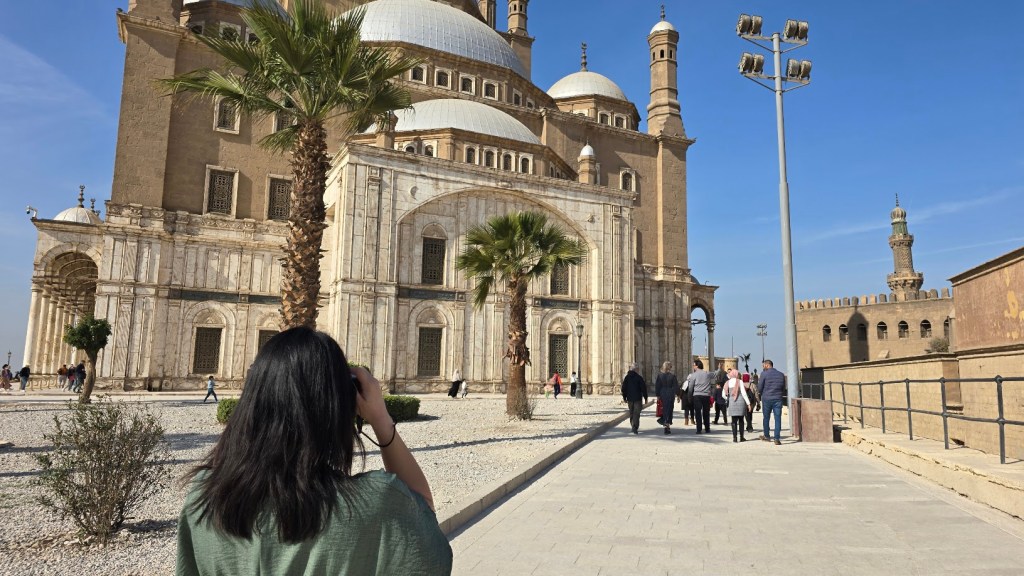
During both our recent trips we made a visit to the Citadel, in Cairo. This impressive fortress, is one of the first sites you see when entering the city of Cairo and is most likely the one you’ll visit first.
Formally named The Citadel of Sultan Salah al-Din al-Ayyubi (Saladin), the Citadel consists of several structures built over the centuries and is one of the most iconic monuments in Islamic Cairo. It’s strategically located on the Muqattam Hills, one of the highest points in Egypt, which gave it a formidable defensive position as well as an unrestricted panoramic view of Cairo (perfect for photos).
According to Egypt’s Ministry of Tourism,
Sultan Salah al-Din al-Ayyubi was the first to order the construction of a fortress over the Muqattam Hills in (572 AH/ 1176 AD), but it was not completed during his lifetime. This was achieved during the reign of Sultan al-Kamel ibn al-Adel (604 AH/1207 AD) who decided to reside in it, making it the official residence of the rulers of Egypt for (for 700 years). In the mid-nineteenth century, Khedive Ismail moved the official residence to Abdeen Palace in downtown Cairo.
The Citadel witnessed some of the most significant events in Egyptian history from the time it was built to the end of the Muhammad Ali Dynasty, which was in power from the early nineteenth century until the 1952 revolution, when the modern Egyptian republic was born.
Many monuments were added to the Citadel over the centuries, providing visitors today with an array of places to visit, such as the Mosque of Muhammad Ali Pasha, which dominates the Citadel (more detail below). Other places to visit include the mosque of the Mamluk sultan al-Nasir Muhammad ibn Qalawun, the Ottoman-era Sulayman Pasha al-Khadim Mosque, as well as a number of museums such as the Police Museum, Al-Jawhara Palace Museum, and the Military Museum.
It’s an easy walk up the hill to see the structures.
The first you’ll probably stop by is the the mosque of Sultan alNasir Muhammad ibn Qalawun, the royal mosque during the Mamluk Period. The Mamluk sultan, al-Nasir Muhammad, ordered this mosque be built in 1318 AD. He rebuilt it in 1335 AD and it was widely used by subsequent Mamluk sultans and other Mamluk occupants of the Citadel. This mosque, which has two minarets, is famous for it’s open court surrounded by four porticos which is widely photographed and used on social media. Detail is available here.
Next you’ll usually stop by the Mosque of Muhammad Ali built by Muhammad Ali Pasha in 1848,\ on the site of Mamluk palaces, made primarily from limestone, with one central dome supported by four half domes. This mosque is known as the “Alabaster Mosque,” in reference to its marble paneling on its interior and exterior walls. The mosque’s twin minarets are the highest in Egypt, each reaching a height of more than 275 feet.
According to the Ministry of Tourism:
The mosque was built on the Turkish style that consists of an open court and prayer hall. The prayer hall is a square space that surmounted with a large central dome which surrounded by four semi-domes and four shallow domes in the corners. There are two minbars (pulpits) inside the mosque. The original of the two is made of wood decorated in green. The other was a later addition made of marble.
The outer open court contains a copper clock tower, which was gifted to Muhammad Ali Pasha by Louis Philippe of France in 1262 AH/1845 AD. Muhammad Ali Pasha reciprocated the gesture with an obelisk of Ramesses II’s (c.1279–1213 BCE) that stood in front of Luxor Temple. Today, it stands in the Place de la Concorde Square, Paris.
(Time to give it back now, France??)
And check out the link here for fascinating info on the 18 (!) massive limestone towers of the Citadel, their names, and special details (“machicoulis” are windows from which boiling liquids could be thrown on attackers from above, for example. Who knew?)
 ExploreEgypt
Leave a comment