
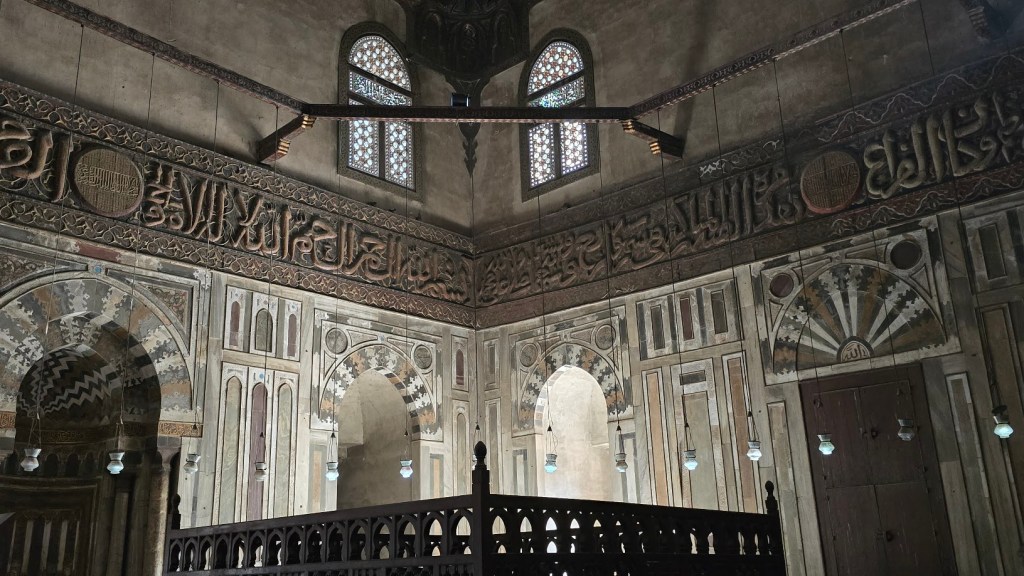
Cairo is known as “the city of a thousand minarets” because of the many mosques that were built when Muslim Arabs came to Egypt.
However, you of course are able to hear the call to prayer at the same times every day, in all of Egypt. The muezzin’s call to prayer, known as the Adhan, is a traditional Islamic ritual performed by a muezzin, a person who recites it, often from a minaret. The Adhan is recited five times a day, marking the beginning of each prayer time.
(I loved the rich soul-stirring sounds of the call to prayer wherever we were in Egypt, it was just beautiful.)
Two mosques we visited in addition to the Mosque of Mohammed Ali at the citadel were the Mosque- Madrasa of Sultan Hasan (madrasa is a school) and the Al-Rifa’i Mosque, which is actually where the Shah of Iran is buried.
Mosque-Madrasa of Sultan Hasan
This mosque is incredible, tucked in between Cairo’s jammed roads and other buildings, and right next to the Al-Rifa’i Mosque (described below).
Sultan Hasan ibn al-Nasir Muhammad ibn Qalawun established this complex in 1356 AD. It’s construction supervisor was Prince Muhammad ibn Biylik al-Muhsini and took seven years to build. Although Sultan Hasan was assassinated before its completion and he was not able to be buried in its mausoleum, it was later used by his two sons.
This complex is made up of a mosque, madrasa, mausoleum, and a student complex to house hundreds of students. It is wonderfully decorated, with striping of different colored stone, and the architecture of the domes and the portal of its main entrance are some of its distinguishing features.
It’s central square open court is surrounded by four monumental iwans, which are vaulted rectangular spaces which are open on one side. Doorways near the corners of the court lead to the four madrasas where the four madhhabs (school of Islamic jurisprudence) were taught.
The domed chamber of the mausoleum is behind the iwan of the qibla, where the mihrah is located. (The mihrah is a niche in the wall of a mosque which marks the qibla, the direction of the Kaaba in Mecca, which Muslims face during prayer.
A marble tombstone, fenced off by beautiful latticework (mashrabiya), lies in the center of the square room.
This complex was witness to many many centuries of events and restorations, and was closed for a long time. At one point the Mamluks took it as a fort to defend themselves against their enemies in the Citadel.
Al-Rifa’i Mosque
Located on Salah al-Din Square (or Maydan al-Qal’a “Citadel Square” more commonly known to Westerners as Maydan Square), al-Rifa’i Mosque was built in the nineteenth century to match its fourteenth-century neighbor, the mosque of al-Sultan Ḥassan.
According to Egypt’s Ministry of Tourism,
The mosque gets its name from the tomb of Ali who was known as “Abu Sheibak”, he was the grandson of imam Ahmad al-Rifa’i. When the mosque was completed, it was imputed directly to Ahmad al-Rifa’i who founded the Rifa’i Sufi order. Although he was never buried here, the mosque (is) witness (to) a joyous annual Sufi celebrations commemorating his birth.
The original structure was a Fatimid* mosque, which was then transformed into a shrine for Ali Abu Sheibak.
Al-Rifa’i Mosque’s architectural design is as interesting as its construction history. Visitors stand in awe of the detailed decoration of the outer walls and massive columns of the outer gate. The minarets are distinguished by their beauty and elegance. Additionally, cement was used in the construction of the mosque for the first time in any of Islamic monument in Egypt, signaling the transition into modern times.
While a section of the mosque is dedicated to prayers, another is reserved for the members of the family of Muhammad Ali Pasha, which was in power from the early nineteenth century until the 1953, when the modern Egyptian republic was born. Khedive Ismail and his mother Hoshiyar Kadin, as well as Kings Fuad I and Farouk, the last two rulers of the Muhammad Ali Dynasty, are buried here, all enshrined in elaborate tombs. The mosque contains the burial chamber of Muhammad Reza Pahlavi (d. 1400 AH/1980 AD), the last Shah of Iran.
See more detail here.
We were fortunate enough to be able to hear the muezzin sing a few ayats (verses of the Quran, which were inscribed on the celing of the room).
In many mosques, for a tip, if a muezzin is available, you may be able to experience firsthand how his voice resonates through the mosque, creating vibrations as the sound scatters across its uniquely designed space.
*A Fatimid mosque is a mosque built during the rule of the Fatmid Caliphate (909-1171 AD), a Shia Islamic dynasty that ruled parts of North Africa and the Middle East. These mosques are characterized by their distinctive architectural styles, which include protruding entrance portals, stone domes, facades with inscriptions, and a notable absence of minarets. They also feature decorative elements like stucco, geometric patterns, and kufic script inscriptions
 ExploreEgypt
Leave a comment