
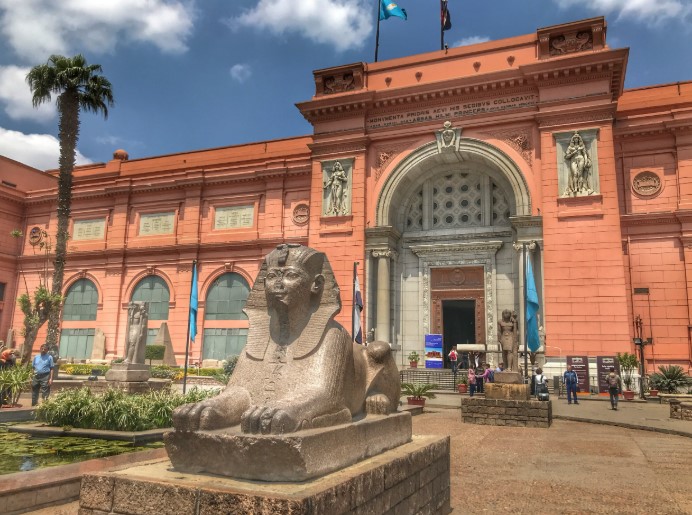
One thing to note when you’re talking about museums in Egypt is – there are a lot of them.
But the ones you’re most likely to visit first are three:
- The Egyptian Museum (the pink museum) officially known as the Egyptian Museum of Antiquities
- The National Museum of Egyptian Civilization (where the royal mummies are displayed) and
- The new Grand Egyptian Museum (opened for real in 2025 and now the largest in the world)
But, as mentioned in my first post, I loved Egypt so much I needed to come back a year after my first visit, and loved the Egyptian Museum so much I was more than happy to visit it again (and hopefully again and again).
The pink Egyptian Museum is one of my all-time favorite museums
and one of the first sites to see when you’re visiting Cairo. The museum, established in 1902, houses more than 170,000 artifacts and hosts one of the world’s largest collections of Pharaonic antiquities and artifacts, spanning from the Pre-Dynastic Period to the Greco-Roman Era (c. 5500 BCE – AD 364).
It is the oldest archaeological museum in the Middle East.
The Museum was first established on the banks of the Nile, in Cairo’s Bulaq district, in 1863 by French Egyptologist August Mariette.
Over time, its extensive collection continued to grow, but in 1878, one of the worst floods in Egypt’s history completely destroyed much of the building, as well as some of Mariette’s drawings and excavation documents. The artifacts were temporarily relocated to the royal palace of Ismail Pasha at Giza after the catastrophe.
According to Egypt’s Ministry of Tourism,
Construction on a new museum began in 1897 at its present location in Tahrir Square, an address that’s now known as the site of protests during the Egyptian Revolution of 2011, part of the Arab Spring. It officially opened its doors to the public on November 15, 1902.
The Egyptian Museum is the oldest archaeological museum in the Middle East, and houses the largest collection of Pharaonic antiquities in the world. The museum displays an extensive collection spanning from the Predynastic Period to the Greco-Roman Era.
The architect of the building was selected through an international competition in 1895, which was the first of its kind, and was won by the French architect, Marcel Dourgnon. The museum was inaugurated in 1902 by Khedive Abbas Helmy II, and has become a historic landmark in downtown Cairo, and home to some of the world’s most magnificent ancient masterpieces.
Among the museum’s unrivaled collection are the complete burials of Yuya and Thuya, (Pharaoh Akhenaten’s grandparents), Psusennes I and the treasures of Tanis along with the Narmer Palette commemorating the unification of Upper and Lower Egypt under one king, which is also among the museum’s invaluable artifacts. The museum also houses the splendid statues of the great kings Khufu, Khafre, and Menkaure, the builders of the pyramids at the Giza plateau. An extensive collection of papyri, sarcophagi and jewelry, among other objects, completes this uniquely expansive museum.
When you first enter the grounds of the museum,
make your way through the garden courtyard which contains a reflecting pool with papyrus, statues and a monument dedicated to Mariette.
Before you enter take a good long look at the beautiful Beau Arts Style façade, and as you get closer be sure to look up at the keystone arch with its Art Nouveau styling of the Goddess Isis wearing the headdress of Goddess Hathor – a solar disc representing Ra, the Sun, cradled between the horns of a cow.

The two architectural sculptures on either side of the museum’s entry arch represent the Goddess Isis, as both day and night (her eyes are open on one statue, closed on the other).
The keystone sculpture above the arch represents the Goddess Hathor, with her headdress of horns and the sphere, representing the sun god Ra.
All three were sculpted by the French artist Ferdinand Faivre (1860-1937).
You’ll first enter the “great hall” of the on the ground floor which displays massive objects like statues, sarcophagi, large stone tablets (and lots of people taking selfies), while the second floor features smaller artifacts such as jewelry, papyrus scrolls, and funerary objects as well as various mummies and items from King Tutankhamun.
The museum is arranged roughly chronologically, starting with the Old Kingdom and moving through the Greco-Roman period.
Key Exhibits include:
Royal Tombs of Tanis: Displays treasures from the tombs of kings and queens of the 21st and 22nd dynasties
Statues: Including those of King Khufu, Khafre, and Menkaure (builders of the Giza pyramids)
Tutankhamun Collection: While some exhibits have moved to the National Museum of Egyptian Civilization and the Grand Egyptian Museum, the Egyptian Museum still houses significant pieces from Tutankhamun’s tomb
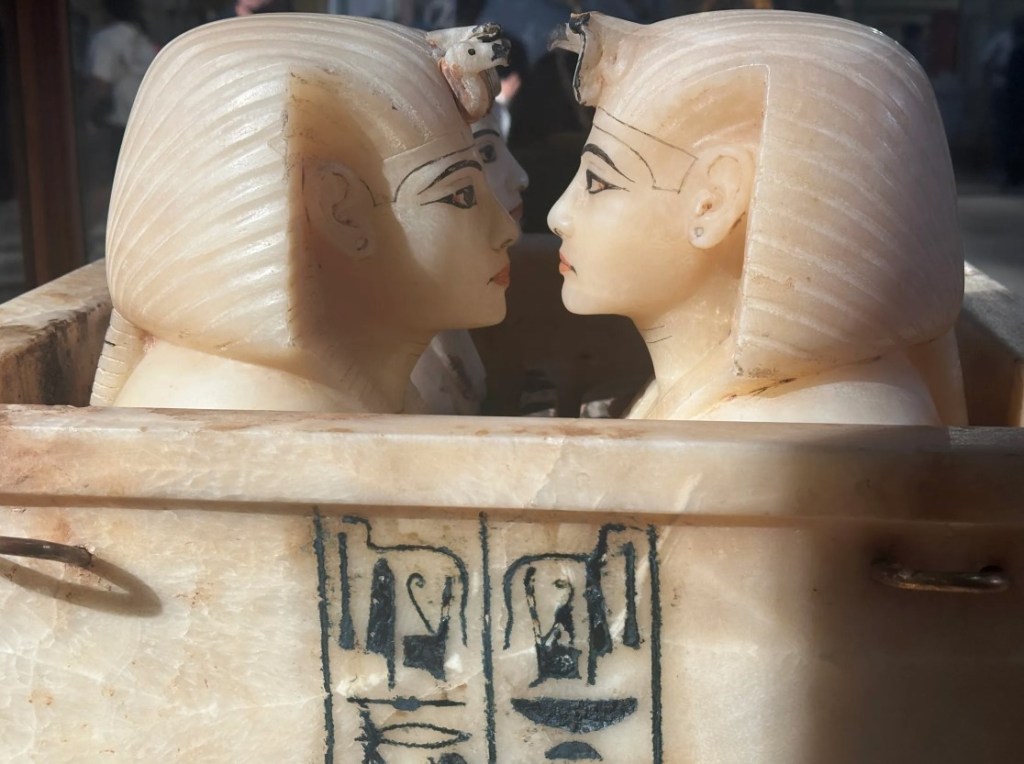
Many people have commented on the museum’s “disorganization” and antiquated feel
but to many (including me) that’s part of its charm.
You can catch a glimpse of what’s behind apartition wall and get what feels like a sneak peek into the storage area of the museum. Many artifacts are stored in glass fronted wooden display cases from the turn of the last century, and you’ll often see typewritten paper labels describing what you’re seeing.
It’s like taking a step back in time and participating in something authentically old – no stark white walls and sanitized digital displays here.
 ExploreEgypt
Leave a comment