
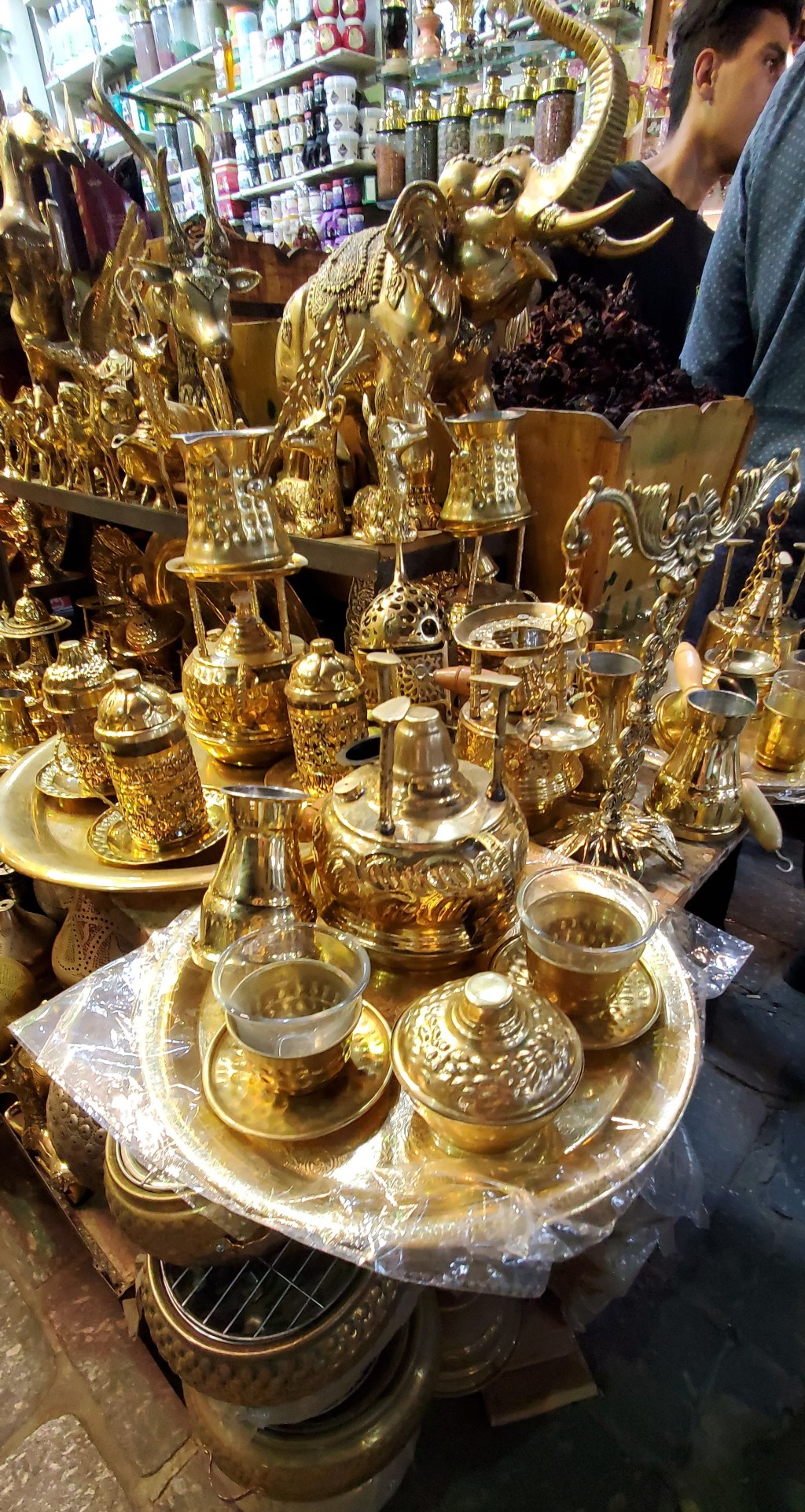
We toured Khan el-Khalili Bazaar twice, once in a larger group in the evening in November 2023 and once again during the day on our recent family trip.
Heads up: First of all, always go with a guide
If you try to go by yourself you will 1) get lost 2) be stopped by numerous vendors and 3) see, learn and understand less than you otherwise would.
When to go – if you’re looking to actually do some shopping or browsing, go to Khan el-Khalili during the day (with your guide) so you can see the sites and browse the shops.
If you’re really just looking to experience the vibe, go in the evening (with your guide). Khan el-Khalili is absolutely magical at night, it’s like you’ve stepped back nearly 700 years in time.
Look up.
This is a rule I try to follow wherever I go but it’s a “must do” when you’re in Cairo. The architecture is incredible, you’ll see medieval buildings and mosques, and decorative window trims and moldings on many of the ancient buildings.
Look down.
The streets, even thought they’re paved, can be uneven at times – you’re walking where people have walked for more than 700 years so it’s good to pay attention. Often the shops will be up a couple of steps, just something to keep in m ind as you’re wandering through this incredible place.
Be sure to:
- meander the bustling streets, it is truly a feast for the eyes, the head, and the heart
- check out the spice shops and buy some cardamon, saffron, hyacinth, the spices are amazing
- sample some Egyptian coffee – you’ll be primed for the rest of the day (or night!)
- look out for the bread sellers, usually young guys on bikes carrying giant loaves of aish baladi, a round, whole wheat flatbread that is a daily staple in Egyptian households.
- Bargain like crazy
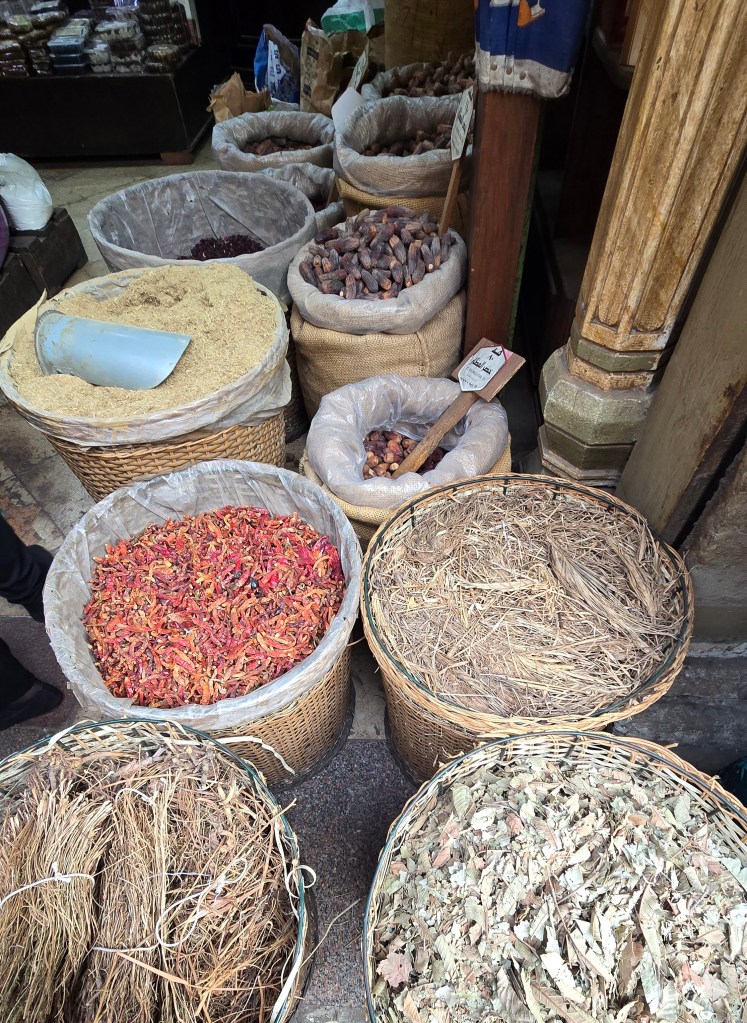
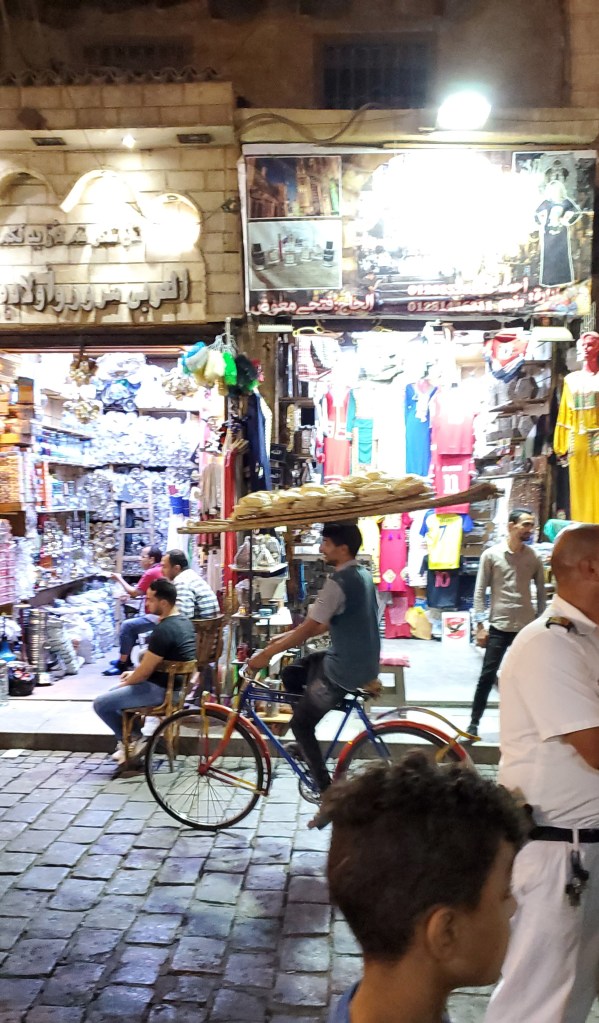
Overview:
Khan el-Khalili is probably the most famous bazaar and souq (or souk) in the historic center of Cairo. Established as a center of trade in the Mamluk era and named for one of its several historic caravanserais, the bazaar district has since become one of Cairo’s main attractions and a distinctive part of its history.
The name Khan el-Khalili historically referred to a single building in the area; today it refers to the entire shopping district.It is home to many Egyptian artisans and workshops involved in the production of traditional crafts and souvenirs.
Food:
Khan el-Khalili is a foodie’s paradise. Savor the aroma of that Egyptian coffee, stop at a café to try some baklava and other local delicacies at the entrance to the bazaar.
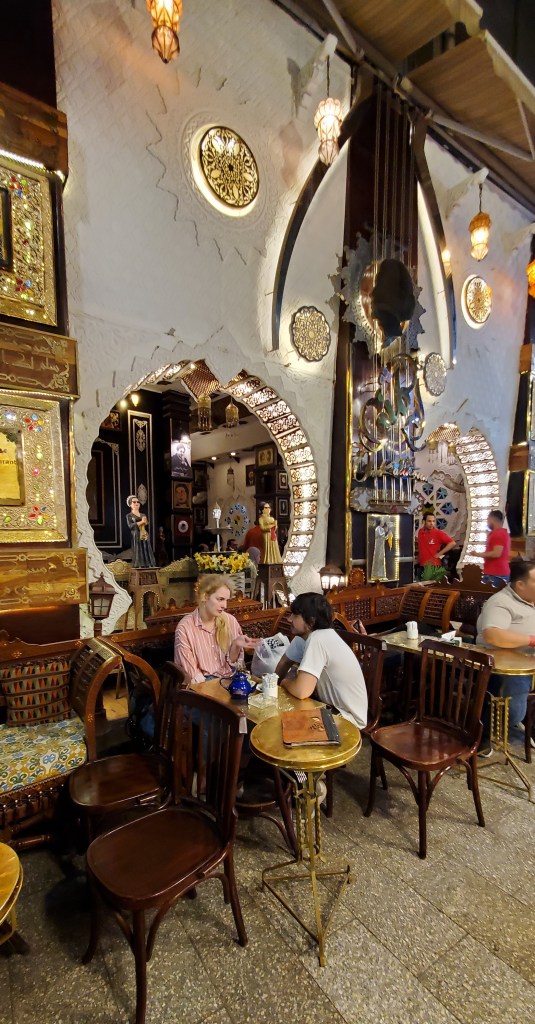
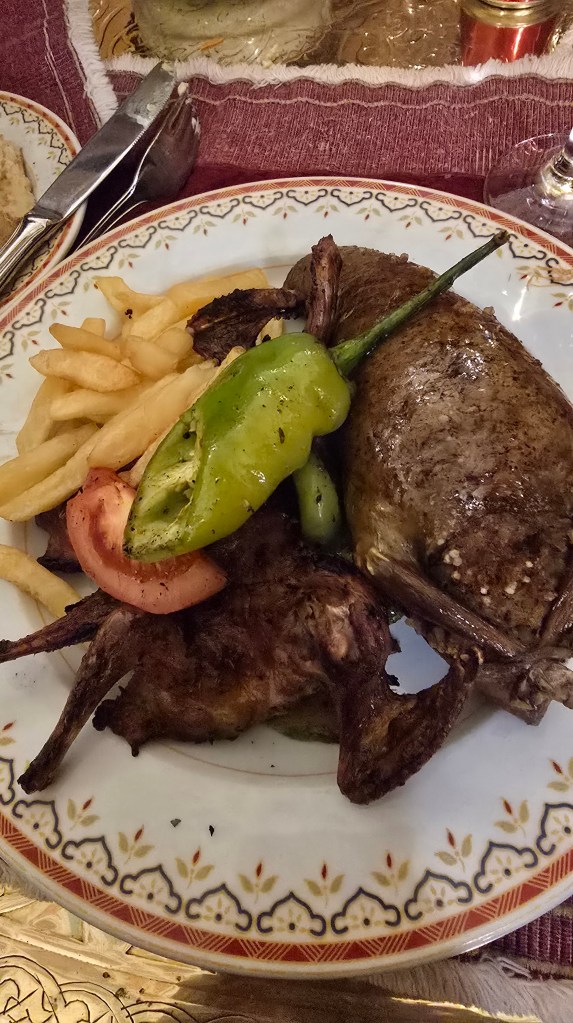
Get a taste of traditional Egyptian food (I had both “Hamaam Mashwi” (grilled pigeon) and “Hamam Mahshi” (stuffed pigeon). so good!!) and be prepared to order too much, it’s all delicious, great ambiance, music at night, reasonable prices (but high end for Egypt).
Shopping:
If you’re with your guide, they’ll let you know the best places to stop to browse or purchase items. You’ll see a glittering array of handcrafted jewelry, exquisite textiles, tapestries, and intricate woodwork, all reflecting the mastery of skilled artisans who have honed their craft for generations.
History (there’s a lot):
According to its website,
The Khan el-Khalili bazaar dates back centuries and has been an important part of Cairo since its establishment in 1382 by Emir Djaharks el-Khalili. In addition to being a popular shopping destination, it was also used as a political gathering place during the Mamluk period (1250–1517). Today, it’s the largest souk in all of the Middle East, with over 4,000 shops spread across its winding alleys.
Here’s some deeper history: Fatimid times (10th-12th centuries)
Cairo was originally founded in 969 CE as a capital for the Fatimid Caliphate, an empire which by then covered much of North Africa and parts of the Levant and the Hijaz. Jawhar al-Siqilli, the general who conquered Egypt for the Fatimids, was ordered to construct a great palace complex to house the caliphs, their household, and the state’s institutions.[2] Two palaces were eventually completed: an eastern one (the largest of the two) and a western one, between which was a plaza known as Bayn al-Qasrayn (lit. ’Between the Two Palaces’).
The site of Khan el-Khalili today was originally the southern end of the eastern Fatimid palace as well as the location of the burial site of the Fatimid caliphs: a mausoleum known as Turbat az-Za’faraan (‘the Saffron Tomb’) Also located here was a lesser palace known as al-Qasr al-Nafi’i (today the site of the 19th-century Wikala of Sulayman Agha al-Silahdar).
Under the Fatimids, Cairo was a palace-city which was closed to the common people and inhabited only by the Caliph’s family, state officials, army regiments, and other people necessary to the operation of the regime and its city. The first attempts to open the city to merchants and other outsiders took place in the later Fatimid period, on the initiative of powerful viziers. Between 1087 and 1092, Badr al-Jamali, the vizier under Caliph al-Mustansir, undertook the task of enlarging the city and building the stone walls and gates that still partly exist today. At the same time, he also opened the city to the common people, but the decision was quickly reversed.
Between 1121 and 1125, al-Ma’mun al-Bata’ihi, vizier under Caliph al-Amir, undertook many reforms and construction projects, including the creation of a mint, known as the Dar al-Darb, and of a customs house for foreign merchants, known as the Dar al-Wikala. These were placed in a central location not far from the current site of the 15th-century Madrasa of al-Ashraf Barsbay. This introduced foreign trade into the heart of the city for the first time.[5]: 199 (vol. II)
Development of Cairo as economic center (12th-14th centuries)
Cairo was only definitively opened to all people under the rule of Saladin, who dismantled the Fatimid Caliphate in 1171 and embarked on the construction of the new Citadel further south, outside the walled city, which would house Egypt’s rulers and state administration.]
This started a process by which Cairo became kown as an economic center inhabited by Egyptians and frequented by foreign travelers. At the same time, the nearby port city and former capital of Fustat, until then the economic hub of Egypt, was in a slow decline, further paving the way for Cairo’s ascendance.
The main axis of Cairo was the central north-to-south street known as the Qasaba (now known as al-Muizz Street), which ran between the gates of Bab al-Futuh and Bab Zuweila and passed through Bayn al-Qasrayn. Under the Ayyubids and the later Mamluks, this avenue became a privileged site for the construction of religious complexes, royal mausoleums, and commercial establishments. These constructions were usually sponsored by the sultan or members of the ruling class. This is also where the major souqs of Cairo developed, forming its main economic zone for international trade and commercial activity thereafter.
Be sure to look for the gate and remains of the Ayyubid-era Salihiyya Madrasa, founded in 1242, on the western edge of Khan el-Khalili today.

An important factor in the development of Cairo’s economic center was the growing number of waqf institutions, especially during the Mamluk period. Waqfs were charitable trusts under Islamic law which set out the function, operations, and funding sources of the many religious/civic establishments built by the ruling elite.
Funding sources often included the revenues of designated shops or other commercial establishments. Among the early and important examples of this institution in Cairo’s center was the complex of Sultan Qalawun, built in 1284–85, which included a madrasa, hospital, and mausoleum. A part of the complex’s revenues came from a qaysariyya (a bazaar or market complex made up of rows of shops) that was built in front of the nearby Ayyubid-era madrasa of al-Salih. This qaysariyya was a prominent early example of the purpose-built commercial structures that came to be erected in Cairo under the Mamluks as part of a waqf. Qalawun’s qaysariyya had a front on the Qasaba street while some of its shops were reached by an inner alley off the main street.[5]
Foundation of Khan al-Khalili in the Mamluk period (14th-15th centuries)
Over many years, space along the Qasaba avenue steadily narrowed as new constructions encroached on it and open spaces disappeared. As the main street became saturated with shops and space for further development there ran out, new commercial structures were instead built further east, close to al-Azhar Mosque and to the shrine of al-Hussein, where some space was still available.
Instead of hosting mobile market stalls that were assembled in open spaces, the city’s souq areas were progressively replaced by fixed stone structures with built-in spaces for individual shops. This was partly a consequence of the authorities wishing to impose greater control on commercial activities: fixed structures could be counted, taxed, and regulated more easily than makeshift market stalls that could come and go.
As the city became denser and space ran out, builders preferred to build multi-storied structures known as a khan (Arabic: خان) or a wikala (Arabic: وكالة), a type of caravanserai (inns for merchants). These types of buildings were centered around an inner peristyle courtyard where merchants could store their goods, while the upper levels were used as living quarters. Their street facades typically had spaces for shops at ground level. In this way, a commercial zone could extend around and between multiple khans.
By the time of Sultan Barquq (r. 1382–1399), the first Burji Mamluk sultan, Egypt had been significantly affected by the ravages of the Black Death but continued to be the center of great economic activity, with many commercial and religious buildings still being constructed at this time.

The creation of Khan el-Khalili
During Barquq’s first reign (1382–1389) his Master of the Stables (Amir Akhur), Jaharkas al-Khalili, demolished the Fatimid mausoleum (Turbat az-Za’faraan) to erect a large khan at the heart of the city. The khan became known as Khan al-Khalili, after his name.
The name eventually came to denote the entire district. Al-Khalili reportedly disposed of the bones of the Fatimid royal family by throwing them into the rubbish hills east of the city.
I guess that’s one way to get rid of the competition.

 ExploreEgypt
Leave a comment