
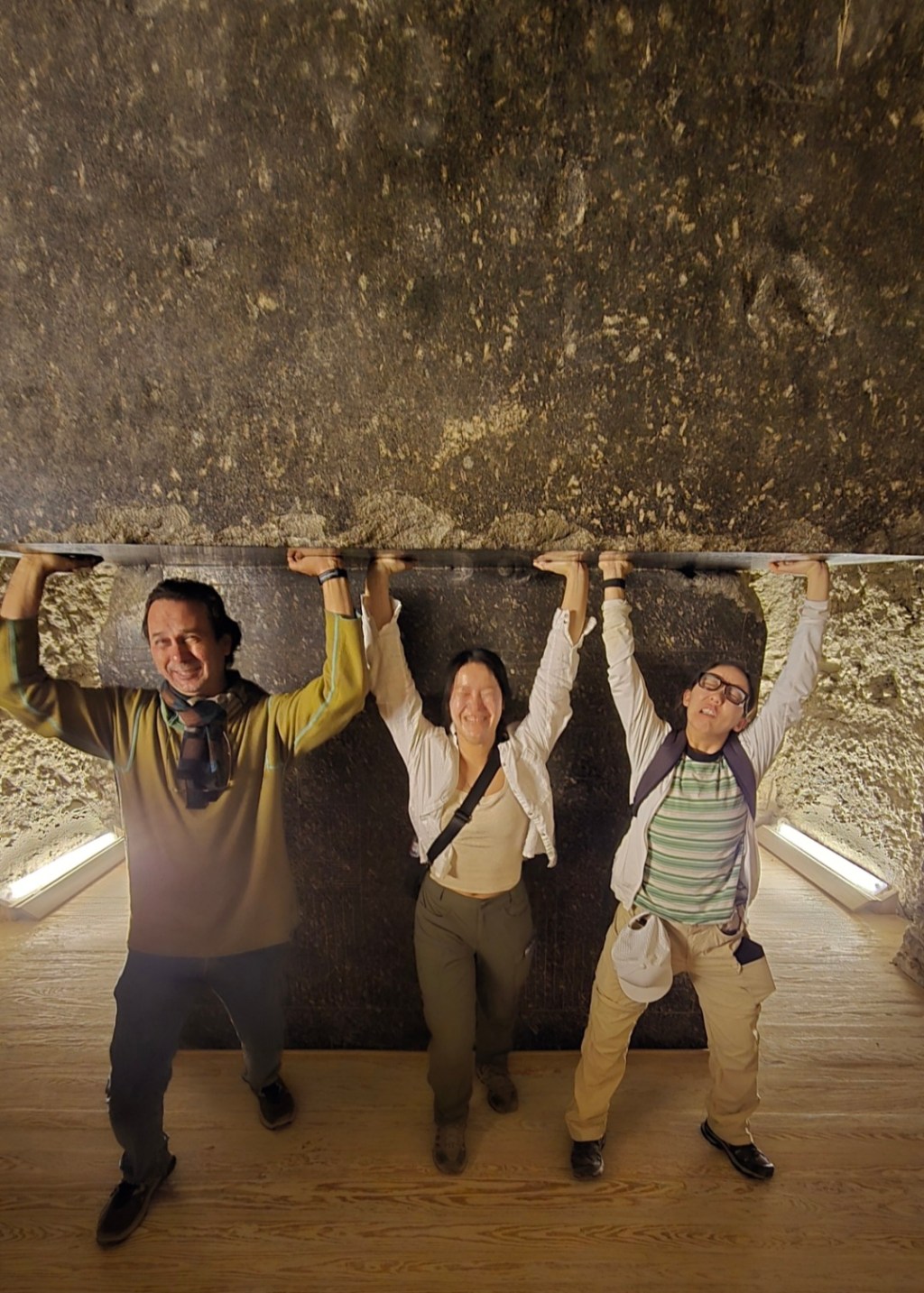
I didn’t know we were going here and I couldn’t believe what I was seeing when we got there.
As part of our one-day trip to Saqqara during my second visit to Egypt (read about the first visit here, for context) we had more time to really explore the necropolis, and it was amazing.
After the Step Pyramid of Djoser and King Unas’ mortuary complex and tomb with a major portion of the Pyramid Texts, we headed to another area where our guide, Egyptologist Fouad Berto, told us we were going to see the Serapeum of Saqqara, where the bulls were buried.
Since we were getting used to being surprised, delighted and amazed, we just went with it.
We drove to another part of Saqqara, parked and looked around where there was not too much to see except sand and vast desert vistas, what looked like several archeological dig sites, and a lovely older man with a donkey (who helped provide our younger daughter with very Instagram-able Egyptian donkey ride pics).
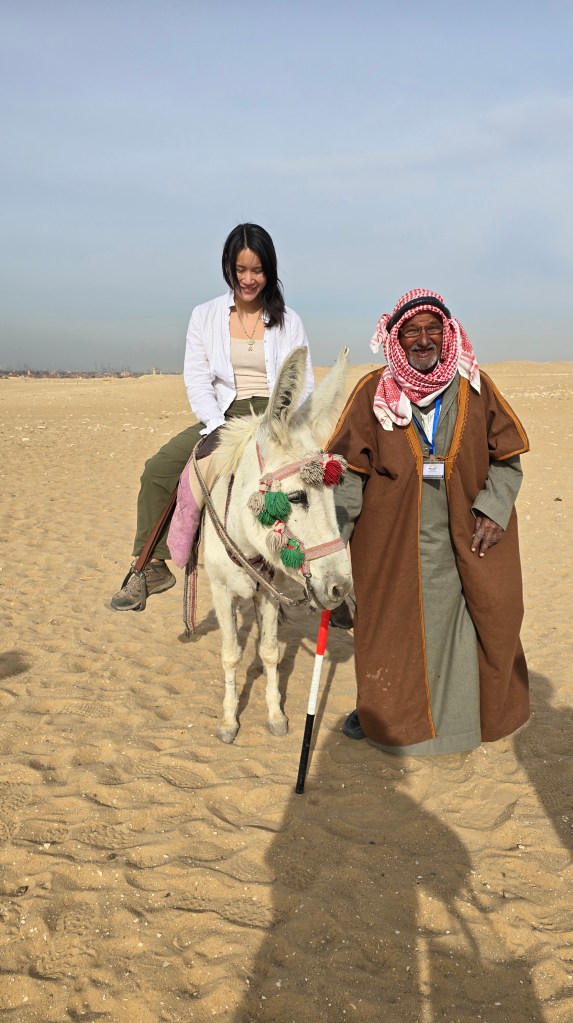
We could actually see the Step Pyramid right behind us, though.
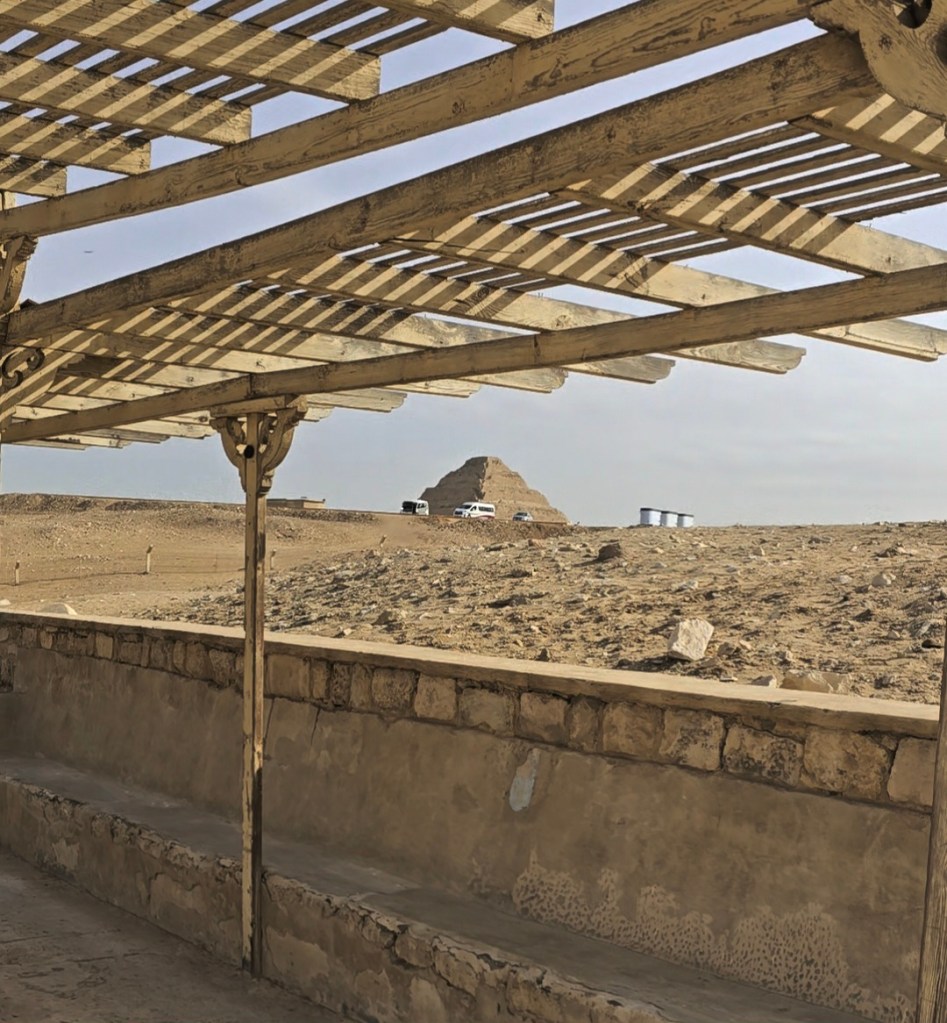
After a few minutes’ walk down a dirt trail from the parking lot to a small pavilion we came to a staircase descending into the ground. To the side of the staircase was a plaque for this place: Serapeum of Saqqara. Even though it led underground, it had a grandeur about it and was extremely well-preserved.


My first question (I knew you’d ask) is: What is a Serapeum, exactly?
The answer? A Serapeum is a temple or other religious institution dedicated to the Greco-Egyptian deity Serapis. Serapis was a syncretic god (“synchretic” means combining aspects of one or more beliefs into a new form of god or religious symbol) combining aspects of Osiris and Apis, two important figures in ancient Egyptian religion.
The Serapeum of Saqqara was an underground burial site built between 1400 BC and 30 BC for the sacred Apis bulls, who were worshipped as divine manifestations of the god Ptah (and later Osiris).
Osiris was one of the most essential deities in ancient Egypt and is regarded as the god of agriculture, fertility, and, most importantly, the afterlife. Apis was a sacred bull deity that was regarded as an intermediary between humans and the divine.
These bulls were ritually selected based on specific markings such as a white spot on its forehead and a black body, and kept in Memphis (one of the first capitals of Egypt) until their death.
The bulls’ deaths marked major religious events tied to gods like Osiris and Ra, while their lives followed symbolic celestial patterns linked to Nile flooding and cosmic cycles.
After their death, their mummified bodies were buried in elaborate ceremonies in the Serapeum. They were worshipped throughout their life and seen as a symbol of fertility and the underworld.
When they died, they were mummified and paraded from Memphis to Saqqara amidst elaborate ceremonies and public mourning. Initially, the bulls were buried inside individual tombs with an above-ground temple in wooden coffins.
About 1,250 B.C.E., Prince Khaemweset commissioned a catacomb nearby to bury the future Apis bulls. Known as the “Lesser Vault” today, this oldest section was closed to visitors due to unsafe conditions.
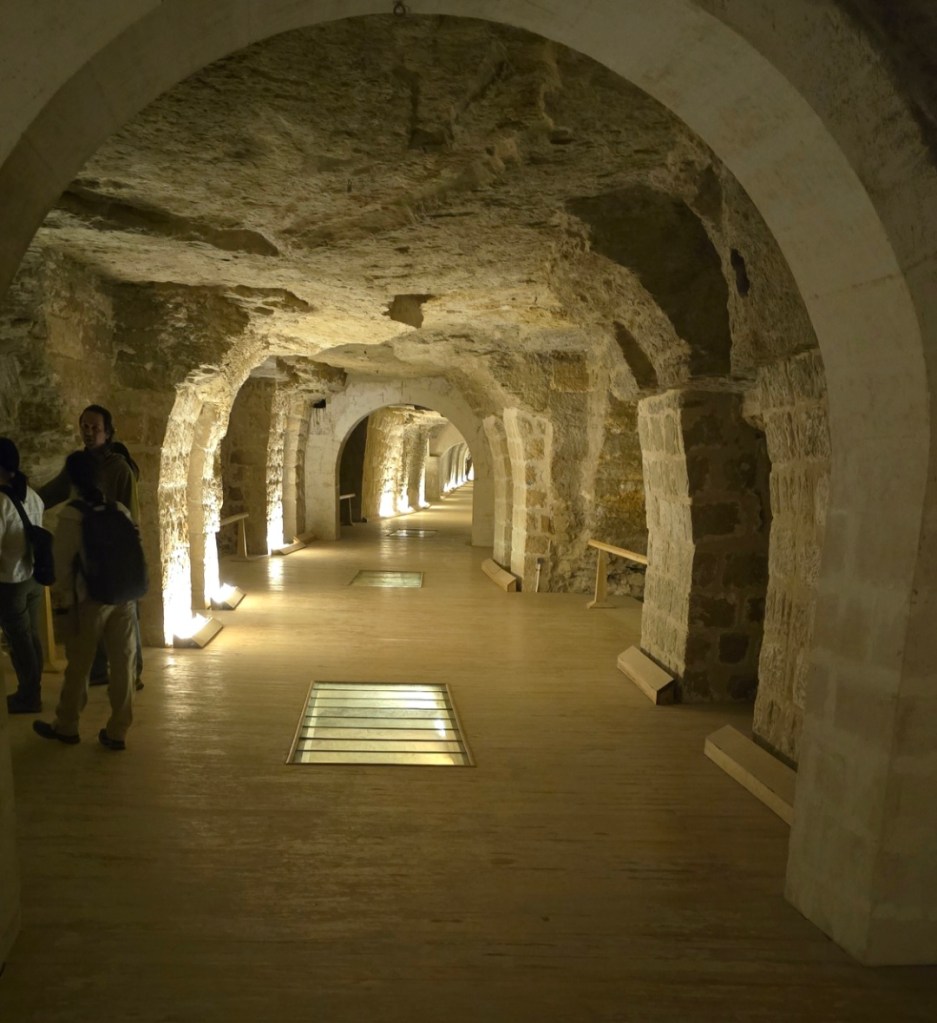
Eight centuries later, Pharaoh Psamtik I restored the temple and added a much larger vault, called the “Greater Vault” today. This new complex is magnificent, and contains curved, vaulted ceilings and structures that look almost modern.
The Sarcophagus
We walked down the main corridor and came to our first Apis bull sarcophagus. It was immense, absolutely awe-inspiring. Made from materials such as granite, basalt or diorite, these sarcaphagi weighed about 60 tons including the lid, and sides that were about a foot thick, covered with hieroglyphs.
How were they moved into place?
No, not aliens.
Archaeologists discovered ancient rails, rollers and winches in the vault, and the tunnels are certainly wide enough to fit the sarcophaguses.
They discovered holes in the ground where the wooden rails would be inserted as part of the pully mechanism. Archaeologists estimate that it only took sixteen men to move one sarcophagus into place.
To lower them into the vault, the floor was first packed with sand. The sand was then dug out from beneath, lowering the sarcophagus gradually until setting it onto the stone floor. (Almost all of these sarcophaguses made it to its final destination – all except one that was just left in the tunnels, for unknown reasons.)
To me, the bigger question is, how were these immense sarcophaguses quarried, in one gigantic piece? What tools were used to so precisely carve out tons of rock to form the interior.
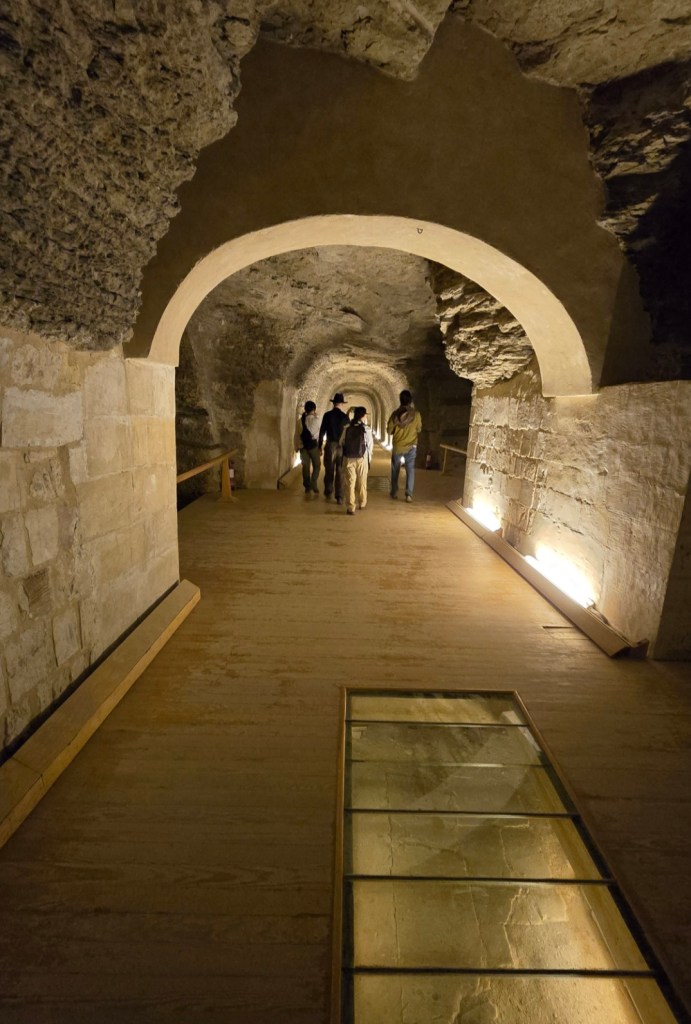
I am pretty sure we would not have the capacity to do this today.
(So, yes, maybe aliens.)
The Serapeum was ordered to be closed during the reign of Augustus Cesar, the first emperor of Rome (legend had it that he said he would only worship actual gods, not cattle, and that was that).
Since its closure, the Serapeum has suffered from many acts of vandalism and theft. Evidence of ancient looting, broken seals, and stolen treasures occurred, and in their continued quest to root out paganism, Christians deliberated scraped off the inscriptions of the bull’s sarcophagus and smashed the commemorative stelae. They even placed stacks of stone on top of the lids to prevent the resurrection of the Serapis cult.
According to this post by Tuljak (which also has some great photos and a somewhat questionable video of the funeral procession of the Apis bull),
The newest sarcophagus in the seraphim is located at the end of the Great Vault. Dated to Cleopatra’s or her father’s reign, Ptolemy XII Auletes, this sarcophagus is unique as it was the only one with original inscriptions intact. Because this is the most fabulously decorated sarcophagus in the Serapium, they constructed an accessible staircase to allow visitors to get up close to see the inscription. The sides of the sarcophagus were incredibly smooth, which is a testament to the enormous skills of ancient craftsmen. Curiously, this sarcophagus was not considered finished. Notably, the cartouches were not filled in, so it is hard to confirm whether this bull was from Cleopatra’s reign.
While the Serapeum was looted in antiquity, plenty of artifacts of lesser monetary value were left inside. When French archaeologist Auguste Mariette rediscovered the place in 1850, the most significant artifacts that could be easily removed were cataloged and sent to France. Mariette was in Egypyt to collect manuscripts in the Middle East on behalf of the Louvre. When unsuccessful in the mission, he made a side trip to Egypt and “accidentally” discovered the Serapeum and other tombs. He became a successful Egyptologist inadvertently. Among the items he collected were thousands of statues and commemorative stelae.
We went to the Serapeum towards the end of a very full day, but it was honestly one of the most astounding sites I’ve seen in Egypt.
I keep thinking about it.
Those massive sarcophaguses, the high vaulted ceilings, the hieroglyphs everywhere, carved into the some of the hardest material on earth. How did they do it?
What technology did the ancient Egyptians possess that we don’t seem to have today?
 ExploreEgypt
Leave a comment