
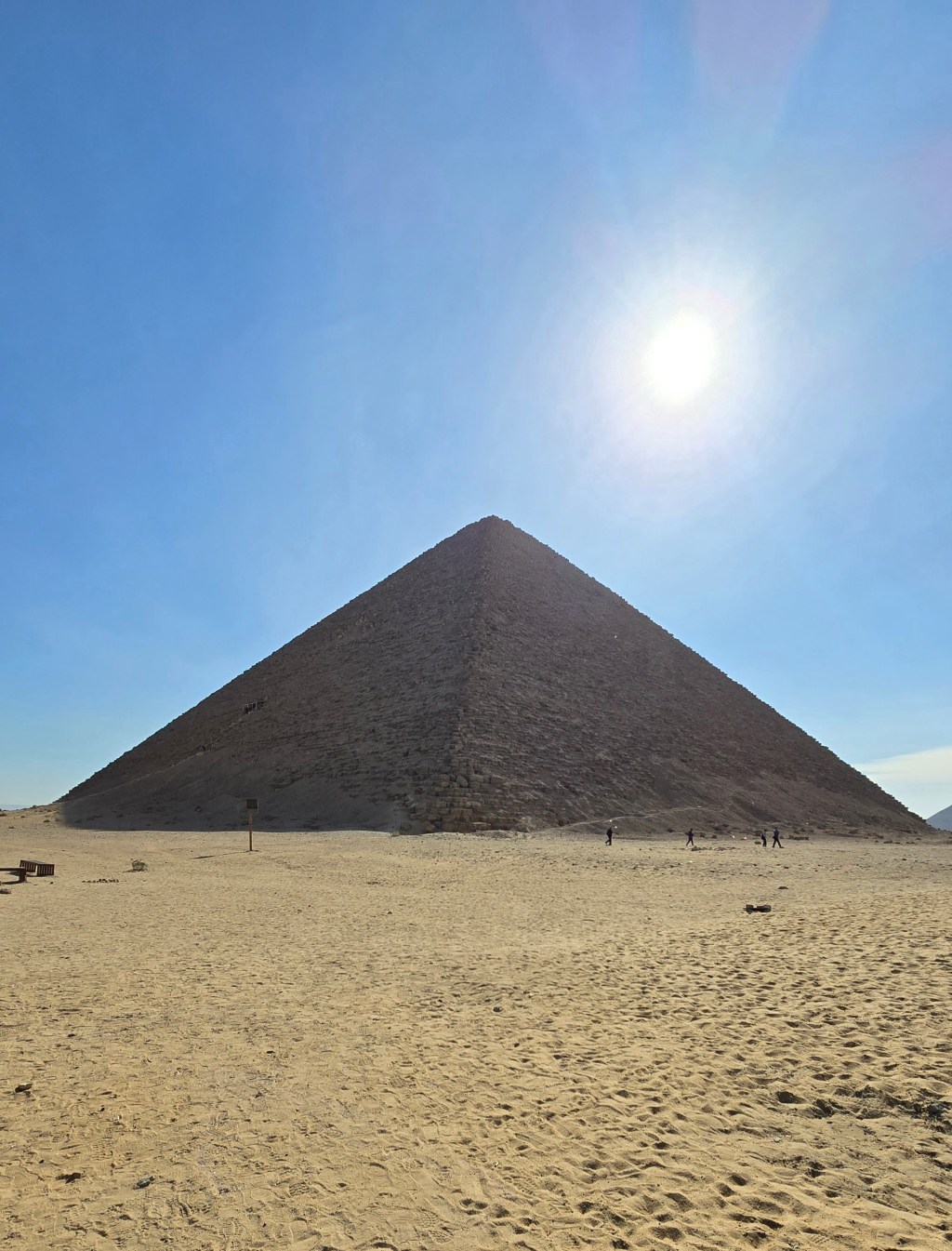
One of the most fascinating places we visited was the Red Pyramid, during our visit to Dahshur (where we also saw the Bent Pyramid, info to come in next post).
The Red Pyramid, also called the North Pyramid, or (as the locals say) el-heram el-watwaat, meaning the Bat Pyramid (spoiler alert: bats live there, you’ll see them if you dare to climb in) is the largest of the pyramids located at the Dahshur necropolis in Cairo, Egypt.
The Red Pyramid was the third pyramid (of either four or five, opinions vary, the two last would have been much smaller) built by Old Kingdom Pharaoh Sneferu, during 2575–2563 BCE, begun in about the thirtieth year of his reign. It is 105 meters (344 ft) high, and 220 meters (720 ft) wide. The other two main pyramids built by Sneferu are the Pyramid at Meidum and the Bent Pyramid.

Our group with our Guide, Egyptologist Fouad Berto.
Opinions vary regarding how long it took to build the Red Pyramid – some Egyptologists believe that it took seventeen years to build it, others believe that it was built in ten. It was supposedly an attempt to build a “true” smooth-sided pyramid, as ancient builders had tried to build pyramids before, but these attempts had failed.
It is believed to be Egypt’s first successful attempt at constructing a pyramid as well as the third largest Egyptian pyramid built, after those of Khufu and Khafre at Giza.
The Red Pyramid is located approximately .62 miles (1 kilometer) to the north of the Bent Pyramid. It is built at the same shallow 43-degree angle as the upper section of the Bent Pyramid, which gives it a more squat appearance than other Egyptian pyramids of comparable scale.
The Red Pyramid was not always red. It used to be cased with white Tura limestone, but only a few of these stones now remain at the pyramid’s base, at the corner. During the Middle Ages much of the white Tura limestone was taken for buildings in Cairo, revealing the red limestone beneath.
What’s it like to go inside?
The original entrance of the Red Pyramids is from the north side. There are three chambers inside the Red Pyramid. The main room of the Red Pyramid contains two million tons of stones.
The Red Pyramid, along with the Bent Pyramid, was closed to tourists for many years because of a nearby army camp. It is now usually open for tourists and a somewhat noisy ventilation system has been installed which pipes air down the entrance shaft to the interior chambers.
To enter, you climb a series of steps cut in or built over the stones of the pyramid to an entrance high on the north side. This entrance is set at the highest point of any pyramid, by the way.
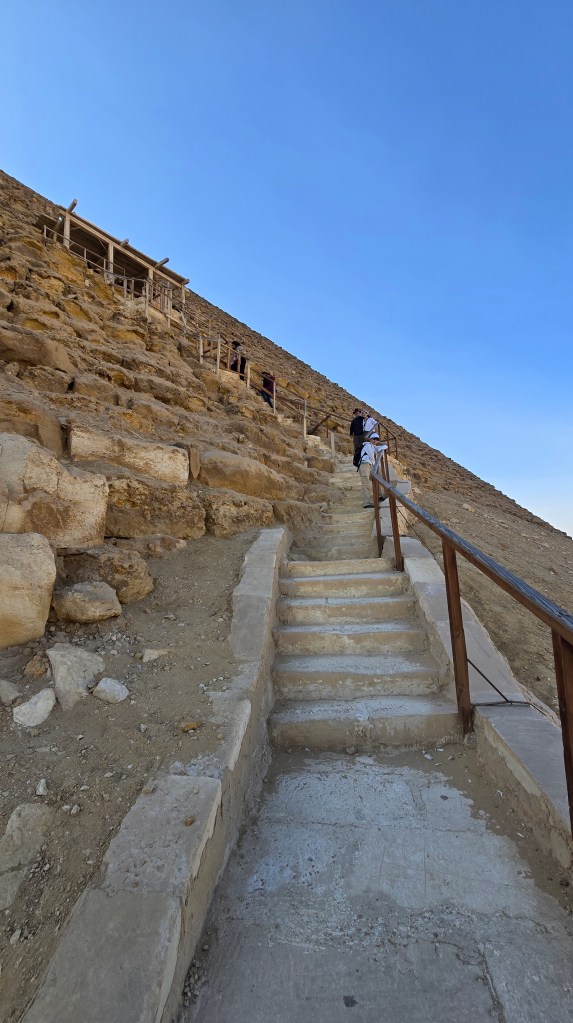
The entrance on the north side.
The descent is also the longest at 203 feet (62 meters) long.
This passage, 3 feet (0.91 meters) high and 4 feet (1.2 meters) wide, slopes down at 27° for 203 feet (62 meters) to a short horizontal passage leading into a chamber whose corbelled roof is 40 feet (12 meters) high and rises in eleven steps.
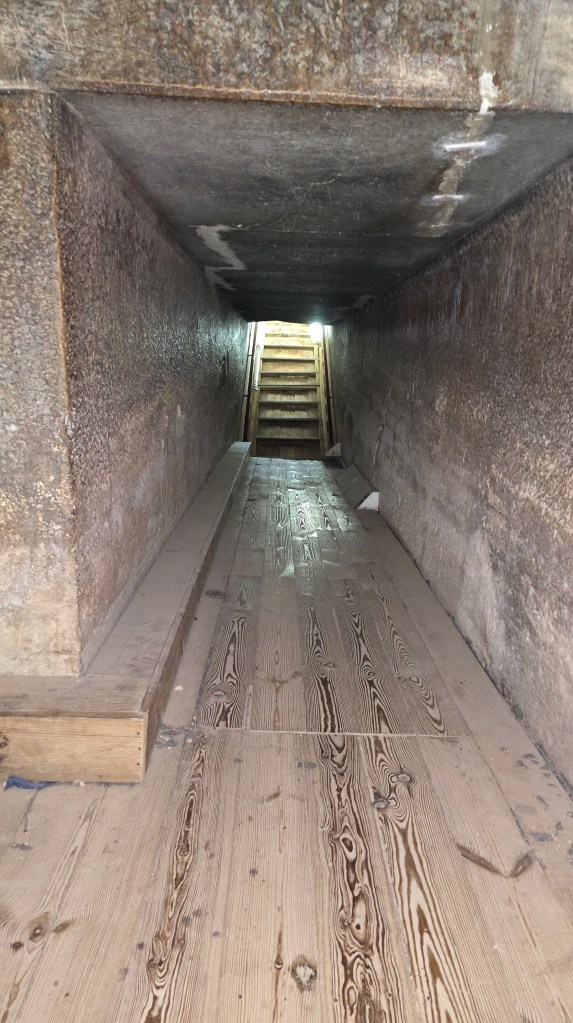
The best way to descend is to go down backwards (a guide will carry a flashlight and go in first in order to light your way down) down a ramp with wooden steps built in for traction. If you’re tall (*raises hand*) you’ll need to make sure you’re bent over – be CAREFUL NOT TO KNOCK YOUR HEAD. One of us made this mistake repeatedly (*raises hand again*).
At the southern end of the chamber, but offset to the west, another short horizontal passage leads into the second chamber. This passage was probably closed at one time and the offset was a measure intended to confuse potential tomb robbers.
The second chamber is similar to the first and lies directly beneath the apex of the pyramid. High in the southern wall of the chamber is an entrance, now reached by a large wooden staircase built for the convenience of tourists.
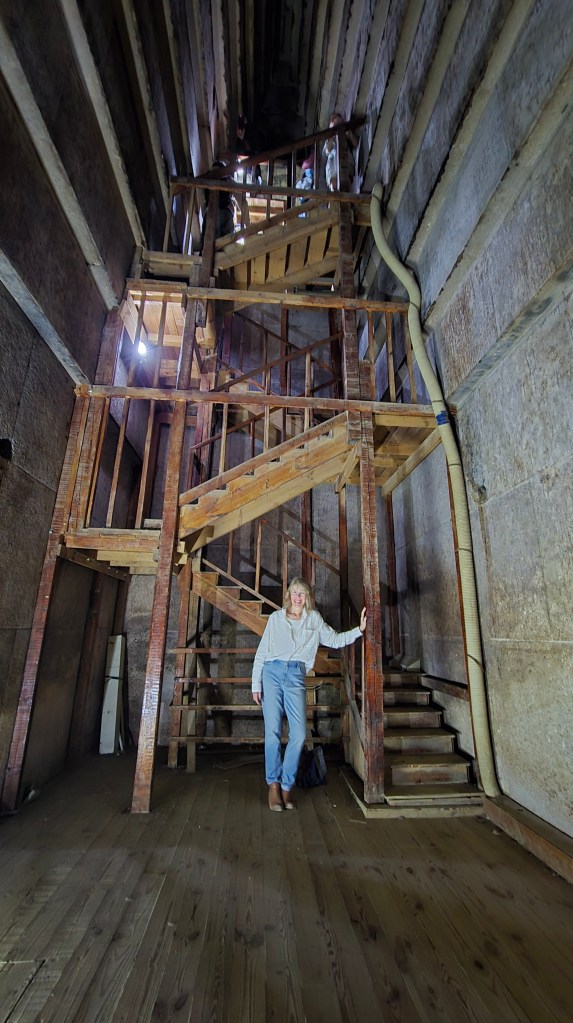
This gives onto a short horizontal passage that leads to the third and final chamber with a corbelled roof 50 feet (15 meters) high. The first two chambers have their long axis aligned north-south, but this chamber’s long axis is aligned east-west.
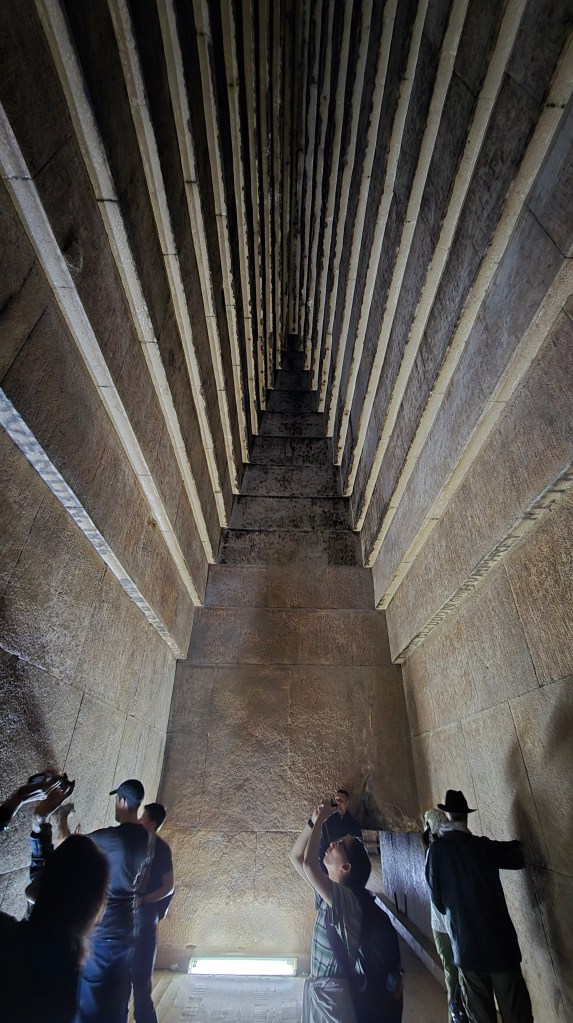
The corbelled roof in the upper chamber. (photo: Susan Serven)
Unlike the first two chambers, which have fine smooth floors on the same level as the passages, the floor of the third chamber is very rough and sunk below the level of the access passage. It is believed that this is the work of tomb robbers searching for treasure in what is thought to have been the burial chamber of the pyramid.
Interesting points about the Red Pyramid
Unique Angle
The Red Pyramid is known for its distinctive angle, which is shallower than the angles of earlier pyramids. According to Egyptologists this was a deliberate choice by Pharaoh Sneferu’s architects to address stability concerns and learn from the structural issues faced by the Bent Pyramid.
- Size
- At a length of about 722 feet (220 meters) on each side and originally around 345 feet (105 meters) in height, the Red Pyramid is one of the largest pyramids in Egypt (although erosion and removal of the outer casing have reduced it to its current height).
- Corbelled Roof Chamber
- The burial chamber inside the Red Pyramid features a corbelled roof, an architectural technique where successive layers of stones are stacked inwards until they meet at the top, creating a pointed ceiling. This design innovation contributed to the stability of the chamber’s roof.
- Lacking Inscriptions
- Unlike many other pyramids and ancient Egyptian structures, the Red Pyramid lacks extensive inscriptions or intricate decorations in its interior. This has led to speculation about the purpose and symbolism of its design.
- Mysterious Burial
- Although the Red Pyramid is often associated with Pharaoh Sneferu, no direct evidence of his burial or funerary items has been found within it.
- Astronomical Alignments
- The layout of the Red Pyramid’s internal passages and chambers is thought by some to have been aligned with celestial phenomena, possibly related to the pharaoh’s journey to the afterlife. This alignment adds to the pyramid’s intrigue and suggests a deep connection to ancient Egyptian beliefs.
What’s the mystery about?
There are several mysterious aspects to the Red Pyramid. The question is: was it ever meant to be a place of eternal rest for Pharaoh Sneferu?
The upper chamber height of the chamber below makes inspecting the access point extremely difficult but the builders left large sockets for pulleys near the hidden corridor, so even with the minimal sources of light that intruders might carry the round sockets would stand out dramatically.
But when you inspect the mouth of the upper corridor you discover the biggest mystery.
The short corridor is uniquely designed. The upper section is perfectly squared and smooth but the lower is roughly cut most likely quarried by intruders looking to make it easier to remove items from the upper chamber. But the way the rock was
But it’s the ceiling of the corridor that defies expectations.
Rather than the ceiling being covered by single blocks, a masonry joint instead runs along the center of the passage ceiling. No other Old Kingdom pyramid was designed in this way. Ancient Egyptians always constructed corridors with lintels designed to span the width of the passage.
It is safe to assume the builders did not want masonry joints in corridor ceilings because it would compromise the structure’s integrity, but here at bottom of the Red Pyramid this corridor bears a heavier load than almost any other pyramid corridor ever built.
The building has held up perfectly which means that the builders were very capable of disguising corridors by using ceiling joints, however in this case they chose not to do so.
At the entrance to its most northern point the ceiling joint does not continue. The first ceiling block is a lintel which spans the entire passage, If the Egyptians were concerned about structural stability or attempting to disguise the upper corridor this design would be backwards. They would instead make this section the only section with a ceiling joint and would have kept the rest of the corridors spanned with lintels for structural support.
So it seems as if the upper corridor’s height was the main form of protection for the Red Pyramid.
Lastly, the enormous excavations in the upper chamber floor is a huge anomaly. Some think the destructive excavation was done to provide a stone ramp to facilitate moving heavy treasures. But even if that were the case, the intruders would not be able to move oversized objects up the 203 foot entry passage.
You’d also need a staging area to keep the treasures you found but the entire floor has been dug out.
The hole the excavated was deeper in the center, shallower at the sides, this is evidence that they were keen to dig downwards at the expense of any other excavation strategy.
What would convince a looting party to dig in the floor in the upper chamber?
Egyptologists cannot say for sure if the Red Pyramid was definitively meant to be Pharaoh Sneferu’s final resting place or not. The mummified body of the Pharaoh, his sarcophagus, nor any funeral offerings have never been found inside the Pyramid.
What do you thnk? Let us know in the comments.

 ExploreEgypt
Leave a comment