
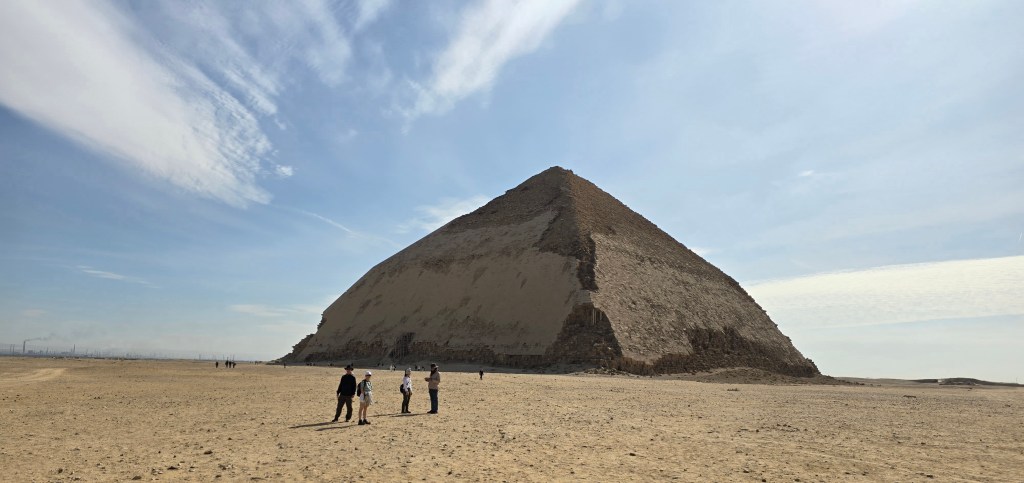
I have a very large book on Egypt that my older daughter gave me for my birthday, before we went on our first trip to Egypt. It talked about the Bent Pyramid of Sneferu and I was absolutely fascinated by it.
We didn’t get to see it up close on our first trip, but I remember seeing it from a distance while we were at Saqqara and asking our Guide, Egyptologist Fouad Berto, if that was actually THE Bent Pyramid (he said it was and explained its significance).
Now we were back for the second time, I was going to get to see THE Bent Pyramid and I thought that was the coolest thing in the world (it pretty much was, up to that point).
What exactly IS the Bent Pyramid?
The Bent Pyramid, constructed by Pharaoh Sneferu of the 4th Dynasty, around 2600 BCE, is one of Egypt’s most iconic monuments, and is considered to be a masterpiece of ancient engineering. Known for its unique shape, it marks a transitional phase in pyramid design, evolving from the step pyramid to the smooth-sided pyramid. It was built from limestone and still retains much of its original polished casing.
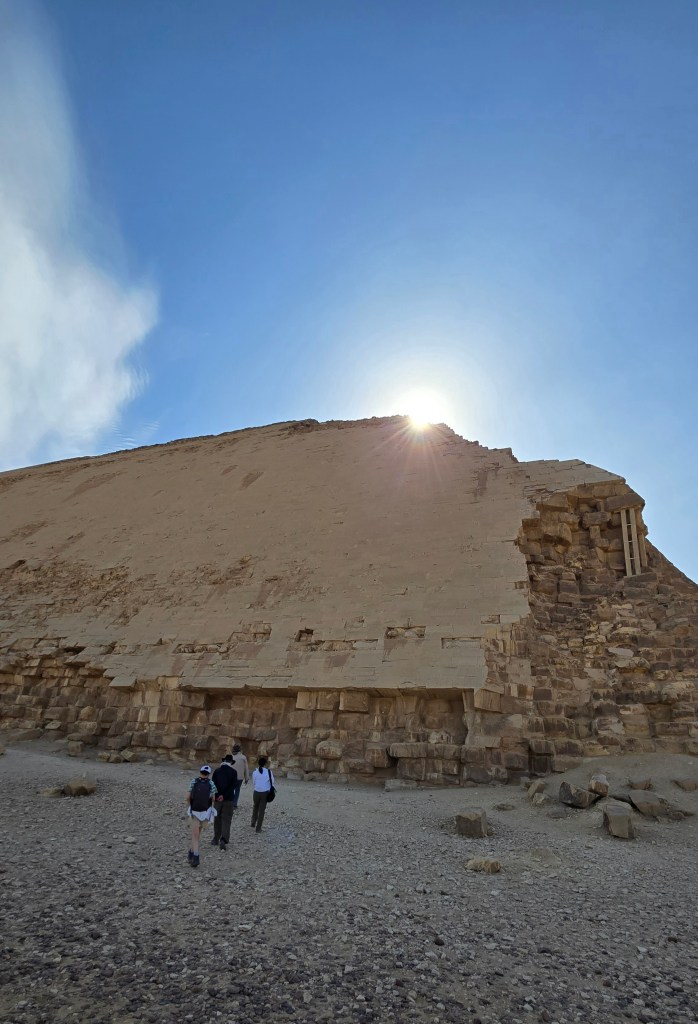
The Bent Pyramid stands at 105 meters tall and has two distinct sections: a lower section that rises at 54 degrees, and an upper section that rises at 43 degrees. This unique shape has earned it its name; it looks like it has been bent at its midpoint.
Despite its steep lower angle and the subsequent change to a shallower slope to prevent collapse, the Bent Pyramid remains a testament to ancient engineering. Built from limestone and retaining much of its original polished casing, the pyramid was part of a grand plan to honor Sneferu and showcase architectural innovation.
The Bent Pyramid has an interesting history
it was originally constructed with its lower angle of 54 degrees but when cracks began appearing in its walls, engineers had to change the angle to 43 degrees in order to prevent further damage from occurring.
(There is actually some controversial debate in more esoteric groups as to whether the Bent Pyramid was actually miscalculated – aka a mistake – or whether a form of sacred geometry ratios were used to build it – but we won’t go into that here.)
Evolution of the Pyramids
The Bent Pyramid forms a midpoint to the timeline of the pyramids’ evolution.
Earlier pyramids were built in step formation, like the Step Pyramid of Djoser, referenced here.
King Sneferau, who reined during the earlier half of the Old Kingdom period (26th century BCE as mentioned above), introduced major innovations in the design and construction of pyramids, and at least three of his pyramids survive to this day. (It is believed that Sneferu was the father of Khufu who later built the Great Pyramid of Giza.)
His first attempt at building a pyramid was the pyramid at Meidum. Architects originally built this pyramid as a step pyramid, to which they then tried to add layers of stone in order to make it a smooth pyramid, but it later collapsed.)
Then Sneferu’s architects had an idea: what if built the step pyramids into something straighter from the beginning?
This attempt resulted in the Bent Pyramid.
Their next attempt was the Red Pyramid, see info here, which is considered the first “true” pyramid.
After that, they constructed the largest Pyramid, Khufu’s iconic Great Pyramid at Giza, then the pyramid of Abu Rawash (a ruined pyramid north of Giza, built by the pharaoh Djedefre, son of Khufu.
(Just to close this loop, the third pyramid at Giza is the Pyramid of Menkaure. It was built for the pharaoh Menkaure, who was the son of Khafre and grandson of Khufu. It is the smallest of the three main pyramids on the Giza plateau.)
According to this article, the Bent Pyramid
“represents both a tomb and a reflection of changing spiritual and architectural concepts in ancient Egypt. The Bent Pyramid holds deeper historical significance due to its unique features and symbolic purposes. While designed as a burial place, the pyramid reflects evolving religious ideologies, marking a shift from step-sided pyramids to smooth-sided ones, symbolizing the solar cult and the sun god Ra. Its bent shape highlights architectural experimentation with stability. The pyramid also symbolizes the union of heaven and earth, embodying Egypt’s cosmic and religious beliefs.”
What’s inside the Bent Pyramid?
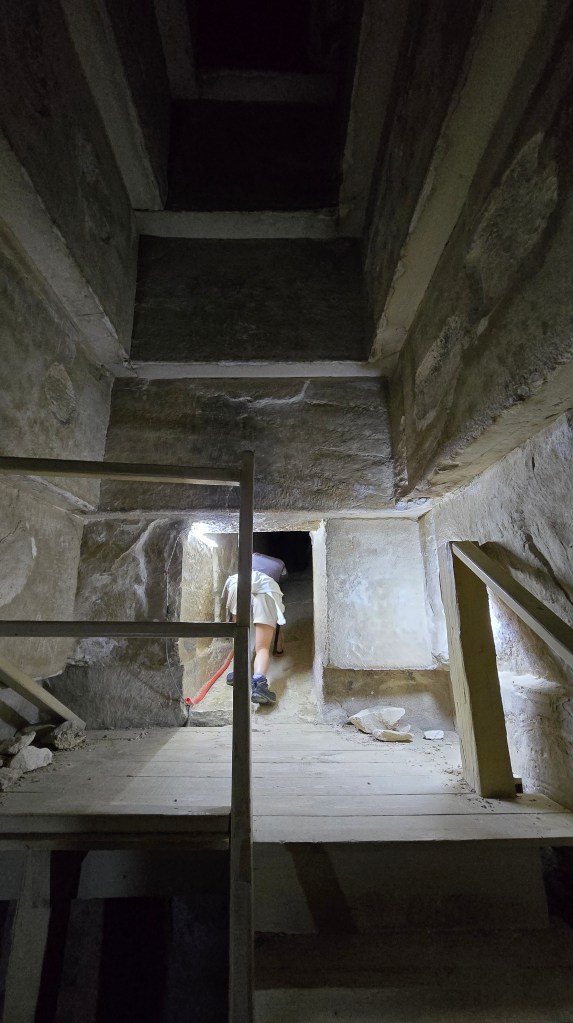
The Bent Pyramid contains a complex internal structure that includes several chambers, passageways, and unique architectural designs. When entering the Bent Pyramid, you can walk (or crouch, if you’re me) through its narrow tunnels and climb down steep passageways to explore the two main chambers.
The Bent Pyramid has two entrances, one on the north side, about 3with modern wooden stairs, and the other is high on the west side.
The northern entrance, which is located about 36 feet above ground level, leads to a descending passageway that ends in an antechamber. Everyone can access the upper chamber, which has a corbelled ceiling. This chamber is large and is thought to have been designed to hold the pharaoh’s sarcophagus, but no burial remains have been found in this chamber.
The western entrance leads to a second, lower chamber located at the pyramid’s base. This chamber is also accessed by a steep descending passage. The lower chamber is smaller and less elaborate than the upper one but features similar corbelled vaulting. This chamber connects to the upper chamber through a sloping passageway.
The Satellite Pyramid of the Bent Pyramid
There is a satellite pyramid is situated about 180 feet south of the Bent Pyramid, which is believed to have been constructed to house the pharaoh’s ka (spirit). It stands 85 feet high and 175 feet long. The corridor of the satellite pyramid design mirrors that of the Great Pyramid of Giza. Inside the burial chamber, a corbel-vaulted ceiling is found along with a 4-meter-deep shaft in the southeast corner, likely dug by treasure hunters. Like the Bent Pyramid, the satellite pyramid also featured an altar on its eastern side, flanked by two stelae.
Lots more info at Egypt Tours Portal here.

 ExploreEgypt
Leave a comment