
When you’re in Cairo, you’re actually close to a number of important archaeological sites that you can visit in a day (including the pyramids of Giza, the Step Pyramid, King Unas’ tomb and the pyramid texts at Saqqara, the Red Pyramid, the Bent Pyramid and Memphis– we like to cram it all in).
This major site centers on the remains of the ancient city of Memphis.
Memphis was the ancient capital of Aneb-Hetch, the first nome (district) of Lower Egypt. The ruins are located just 20km south of Giza, where you can admire the Sphinx and the famous pyramids. Memphis was the capital of Egypt during the Old Kingdom (ca. 2686 BC–ca. 2181 BC), but remained important afterwards. Later kings would often construct monuments in this ancient capital, including Ramesses II (r. 1279–1213 BC), perhaps better known as “Ramesses the Great”.
Memphis was founded around 3100 BCE, by King Menes, who named it Mennofer, meaning “the White Wall.” Memphis (now called Mit Rahineh) served as the first capital of the unified kingdom of Upper and Lower Egypt during the Old Kingdom (2625-2130 B.C.), part of the Middle and New Kingdoms (besides Itjtawy and Thebes), the Late Period and again during the Ptolemaic Period (along with the city of Alexandria).
In 2240 BCE, Thebes – the modern-day city of Luxor – superseded Memphis as capital city, and as the centuries passed it lost its significance in Egypt. Sped up by the founding of Alexandria in 332 BCE, it ended up being completely abandoned by the 7th century CE and became a type of quarry, with the remains of temples and other grand buildings being used to build the new capital city of Al Qahira (now known as Cairo).
However, Memphis remained an important administrative and religious center throughout Egyptian history. The entire region of Giza, Saqqara and most of Cairo is located in the area of Memphis.
The God Ptah
The site of Memphis was sacred to the god Ptah, his consort Sekhmet and the third member of the Memphite Triad, Nefertem.
Ptah, known as the ancient Egyptian god of creation and craftsmanship, was the chief deity of Memphis and is credited with bringing the cosmos into being through his heart and tongue, essentially conceiving and then speaking the world into existence. In some accounts, he is said to have created himself from the void.
Excavation
In 1915 Egyptian Section Curator Clarence Fisher began excavation at Memphis which lasted for 8 years during which he discovered the ceremonial palace of the New Kingdom pharaoh Merenptah (1213-1204 B.C.) as well as other areas, settlements, and a temple precinct dedicated to the god Ptah.
Geography, religion and trade
The unrivaled geographic location of Memphis, both commanding the entrance to the Delta while being at the confluence of important trade routes, means that there was no possible alternative capital for any ruler with serious ambition to govern both Upper and Lower Egypt.
As well as the home of kings, and the center of state administration, Memphis was considered to be a site sacred to the gods.
Memphis continued to retain its importance even after the Ptolemaic dynasty shifted the political capital to Alexandria. The city remained a vital religious hub, where royal coronations were celebrated in the temple of Ptah-Hephaestus.
The Serapeum, a notable site within Memphis, housed the sarcophagi of sacred bulls dedicated to the god Apis (read more here).
The city of Memphis contains many archaeological remains,reflecting what life was like in ancient times, including temples, of which the most important is the Temple of Ptah in Mit Rahina. Other major religious buildings included the sun temples in Abu Ghurab and Abusir, the temple of the god Apis in Memphis, the Serapeum and the Heb-Sed temple in Saqqara.
As the seat of royal power for more than eight dynasties, the city also contained palaces, some of which you can still see today – ruins survive of the palace of Apries which overlook the city. The palaces and temples were surrounded by craftsmen’s workshops, dockyards and arsenals, as well as residential neighborhoods, traces of which survive.

The Colossus of Ramses II
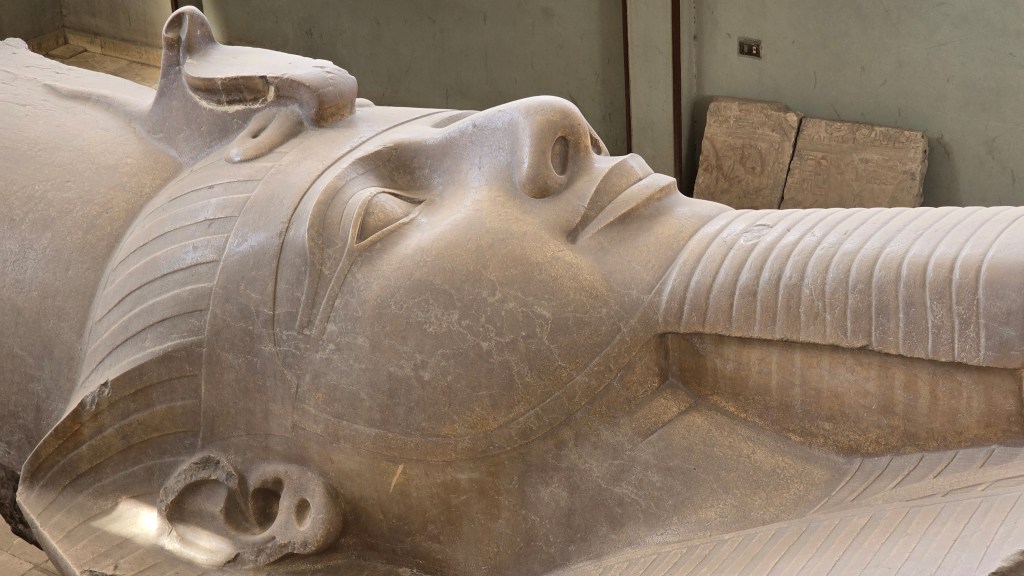
An enormous colossus of Ramses II – displayed lying on its back, allowing you to view its intricate detail- and the immense alabaster sphinx (the second largest found in Egypt) are two of the highlights of this museum.
Actually – fun fact – this colossal statue is one of a pair, the second statue prominently welcomes guests and guards the entrance to the new Grand Egyptian Museum (GEM) at Giza, opened in 2025.
Both statues were carved from limestone and measured about 33 feet in length. Italian explorer Giovanni Battista Caviglia (1770–1845) discovered the first statue near the southern gate of the temple of Ptah in 1820. The statue is displayed on its back because the feet and base are broken off.
The museum that currently houses the statue was built specifically to protect it. You can climb some stairs inside and walk around the statue at a higher level, giving you an excellent vantage point to admire it from different angles.
The second one was also found by Caviglia in 1820. It was restored to its full height in the 1950s. Originally, it was displayed in the Bab Al-Hadid square in Cairo, which was then renamed “Ramses Square.” In 2006, it was moved temporarily to a location in Giza until it was moved to it’s new location at the GEM.
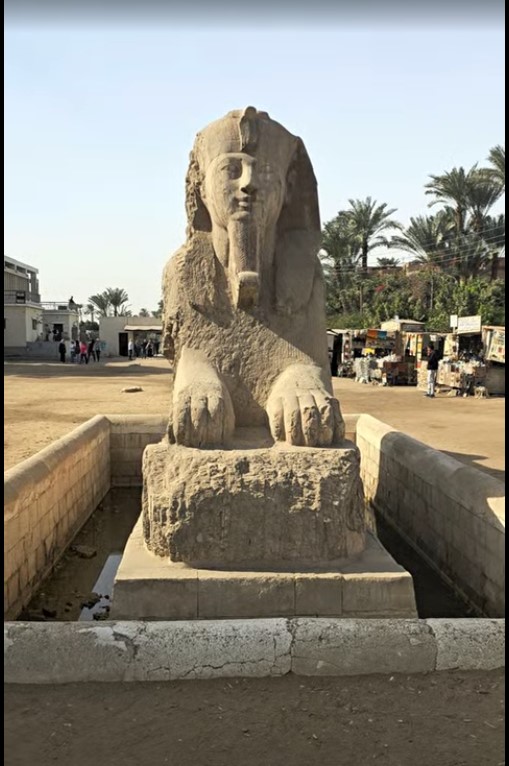
The Alabaster Sphinx
This sphinx was unearthed in 1912 by Flinders Petrie near the remains of Memphis. It is one of the largest monuments ever made from Egyptian alabaster.
Sphinxes are often guards or protectors of ancient Egyptian sacred places. Some represent kings (pharaohs), with their human faces attached to the body of a lion – an animal recognized as the ultimate symbol of power.
There is no consensus on who is represented by this sphinx, because there are no inscriptions on it. However, some theories suggest that it may be Queen Hatshepsut or King Amenhotep II or Amenhotep III.
Despite the dismantling of the ancient capital to build new cities, the open-air museum of Memphis still retains much of its ancient treasure – including ruins and several important statues – and more is uncovered nearly every week, as building continues to move ahead.
It’s definitely worth a trip to see this ever-changing site, learn about the history, and wonder about what’s still left to be discovered under Egypt’s desert sands.
 ExploreEgypt
Leave a comment