

When you travel to Egypt, read about Egypt, you’ll likely come across the Egyptian scarab. It features prominently in any visit to the Temple of Karnak (where people walk around the giant statue of a scarab for good luck) and other sites, and is featured in artwork and funerary tombs and artifacts and elsewhere.
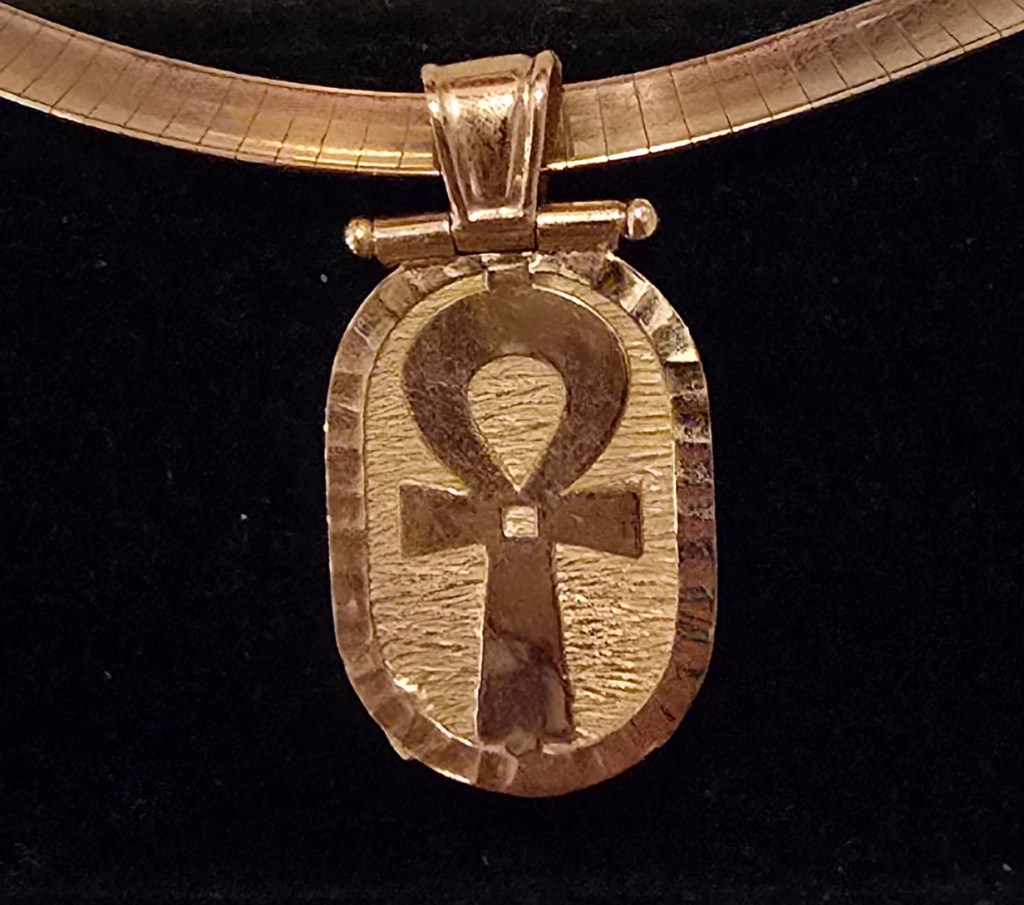
I really wanted to find a scarab pendent on our first visit to Egypt, but it took a return trip to find the one that was meant for me (pictured). It has an ankh on the back, is made of carnelian and lapis lazuli set in Egyptian gold and has tiny ruby eyes. He is my little scarab buddy and I wear him all the time.
Actual scarab beetles, also known as dung beetles are amazing little creatures. They perform crucial ecological functions such as consuming, burying and recycling animal manure, which helps suppress flies and parasites, improves soil fertility and structure, and reduces nutrient runoff.
Scarab beetles are actually unique among insects in that some species navigate by the stars, using the Milky Way as a celestial compass in order to roll their dung balls in a straight line away from the dung pile. They take a kind of “photo” of the sky for orientation, rather than referencing individual stars. Just incredible.
They’re hard little workers – they start by shaping dung into balls and rolling them to a burrow for food or to lay eggs in. After laying their eggs, the adult scarab beetle will emerge, and their larvae will grow and feed on the dung balls before they also emerge to start the process all over again.
Ancient Egyptian observers must have noted this little beetle’s behaviors, and might then have decided to attribute the cycles of creation, rebirth transformation, and the sun’s cycle to them.
The scarab beetle’s behavior of rolling dung balls across the ground was likened to the sun god’s journey across the sky, linking the beetle to the powerful sun deity Khepri, who is often depicted as a scarab or a human with a scarab head. Khepri was associated with the rising sun (specifically the god of the sun rising on the eastern horizon) and the act of creation.
Furthermore, the scarab’s emergence from dung, often seen as a symbol of waste, was associated with spontaneous creation and rebirth, mirroring the Egyptians’ beliefs about resurrection and the afterlife.
Scarab amulets were worn by both the living and the dead for protection and to ensure a safe passage to the afterlife. They were believed to bring good luck, ward off evil spirits and were seen as a metaphor for the soul’s transformation in the afterlife.
They were also used as seals and inscribed with blessings or magical spells. In essence, the scarab was a powerful symbol of life, death, and the continuous cycle of renewal that was central to ancient Egyptian beliefs.
In ancient Egypt, scarab beetles’ colors carried symbolic meanings, often linked to deities and natural elements.
Red signified the sun god Ra, yellow represented the sun and desert, blue symbolized the Nile, and green represented growth. These colors, along with the scarab’s association with creation and rebirth, made it a powerful amulet for both the living and the deceased.
There is a lot more detail at this site, A Tale of Two Worlds, here.
So, if you were an Ancient Egyptian and saw a scarab beetle you wouldn’t just think “oh look, a beetle pushing some dung around” – you’d think of the sun, of the beginnings of the world, of transformation and of life after death.
A pretty heavy load for a busy little beetle to push around.
 ExploreEgypt
Leave a comment