
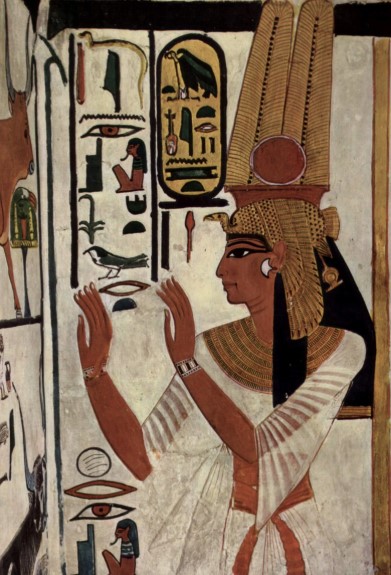
On our first trip to Egypt we were so lucky to be able to visit the magnificent tomb of Queen Nefertari. The site was closed to visitors only a few months later due to ongoing conservation work to combat humidity and protect its delicate wall paintings from deterioration
Nefertari means “The Beautiful Companion,” “The Most Beautiful One” (derived from ancient Egyptian, combining ‘nefer’ (beautiful/good) and ‘tari’ (companion/goddess) or “Beloved of Mut” (when combined with her full name, Meritmut.
Legacy: She was highly educated, skilled in hieroglyphs, and played a vital diplomatic role. Ramesses II honored her with a temple at Abu Simbel and the stunning, well-preserved Tomb QV66 in the Valley of the Queens. Queen Nefertari was a celebrated queen of ancient Egypt who was honored and depicted with divine status, often alongside the goddess Hathor. Although not literally a goddess in the Greek sense, she was portrayed and venerated as semi-divine, blurring the line between queen and deity in the Egyptian imagination.
Who was Nefertari?
Nefertari was the Great Royal Wife of Ramesses II, ruling during Egypt’s 19th Dynasty in the 13th century BCE. Her titles, such as “Great King’s Wife,” “Lady of Grace,” and “Beloved of Mut,” (a powerful Mother-Goddess and the consort of Amun-Ra) reveal her political importance and religious prestige at court.
More than a consort, Nefertari appears in temple scenes participating in major state rituals, including ceremonies at Luxor and Karnak where she stands beside Ramesses in acts of worship. These scenes present her not as a passive figure but as an active ritual partner, sharing in responsibilities normally reserved for the pharaoh.
Queen, Consort, And “Goddess”
In ancient Egyptian belief, the boundary between humanity and divinity was permeable, allowing elite individuals to attain a form of divinity through ritual, memory, and art. Nefertari was portrayed as the goddess Hathor in the temple at Abu Simbel, visually elevating her into the divine realm within that sacred space.
Nefertari’s temple at Abu Simbel is a smaller, but equally magnificent, rock-cut temple built by Pharaoh Ramesses II for his beloved chief wife., Known as the “Small Temple” or the “Hathor Temple,” this temple honors both Nefertari and the goddess Hathor.
Its facade features colossal statues of both Ramesses II and Nefertari at the same height, symbolizing her elevated status and semi-divine identity. Its interior boasts vibrant frescoes and Hathoric columns, all part of the larger Abu Simbel complex saved from flooding by UNESCO in the 1960s.
This temple, dedicated jointly to Nefertari and the goddess Hathor, was a rare honor for a royal wife. The foundation inscription emphasizes her exalted status, while the inner sanctuary is devoted to Hathor, goddess of love, music, and joy.
Reliefs inside the temple show Nefertari making offerings to Hathor and standing as Ramesses’ partner in sacred ceremonies, visually framing her as priestess and divine consort. These images communicate a powerful message: Nefertari is both beloved queen and living embodiment of Hathor’s beauty, charm, and nurturing power.
Starry Skies in Her Tomb
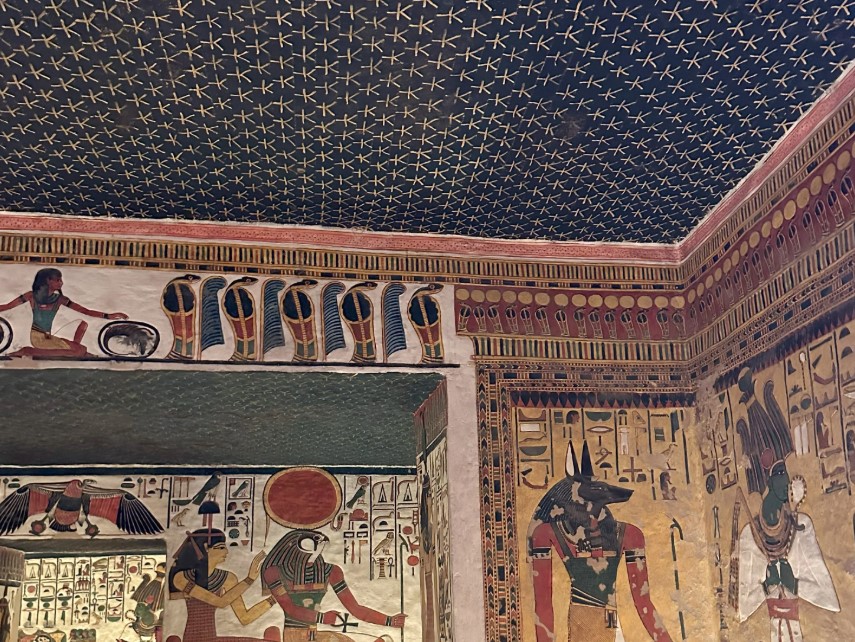
In Nefertari’s tomb, the ceilings are painted deep blue and covered with golden five-pointed stars, explicitly described as an astronomical sky representing the heavens. This transforms the burial chamber into a miniature cosmos where the queen exists eternally under a divine firmament.
If you didn’t know better you’d think the ceilings had been painted yesterday. It’s absolutely magnificent.
Starry ceilings in Egyptian tombs and temples symbolized eternity, order, and the hope that the deceased would dwell among the “imperishable stars,” the undying constellations. For a queen of Nefertari’s stature, this imagery aligns her afterlife with the eternal realm of gods and stars, reinforcing her semi-divine status.
Connection to the Sky Goddess Nut and Eternal Protection
Egyptian theology linked the night sky to the goddess Nut, whose arched body forms the protective dome that separates creation from chaos and receives the dead as stars within her body. Funerary texts ask Nut to “spread herself” over the deceased so they may be placed among the stars, never dying but continually reborn.
In this context, the starry ceilings in Nefertari’s tomb function as Nut’s cosmic body above her, promising protection, rebirth, and safe passage into the ordered universe beyond death – an especially fitting visual for a queen celebrated as “for whom the sun shines.”
Titles, Power, And Personality
Nefertari accumulated an array of titles, including “Beloved of Mut,” “Mistress of the Two Lands,” “God’s Wife,” and famously “The one for whom the sun shines,” a phrase that reflects both political rank and personal affection. These epithets hint at a queen who embodied grace, diplomacy, and religious authority.
In inscriptions, she appears involved in rituals such as appeasing the gods at Gebel el-Silsila, roles typically reserved for the king as Egypt’s chief priest. Such depictions suggest that Nefertari’s presence lent legitimacy and sacred charisma to Ramesses’ rule, reinforcing the image of a divinely favored royal couple.
The Tomb Of A Nearly Divine Queen
Nefertari’s tomb in the Valley of the Queens (QV66) is among the most magnificent of the New Kingdom, often described as a “house of eternity” created at the height of Egyptian craftsmanship. Its location in Ta Set Neferu, “the place of the beauties,” and its lavish decoration underline her exceptional status even among royal women.
Within, vibrant paintings show gods like Neith, Hathor, Anubis, and Osiris guiding Nefertari safely into the afterlife, treating her as a blessed, near-divine being worthy of their personal care. The star-studded ceilings, ritual texts, and scenes of her presented to the gods portray an eternity in which she continues to move in divine circles, forever the radiant “beautiful companion” of both king and gods.
Nefertari’s influence stands out even among powerful New Kingdom royal wives, and the star-filled ceilings in her tomb visually anchor that influence in a promise of eternal, celestial life.
Nefertari vs. Other Great Royal Wives
As Great Royal Wife of Ramesses II, Nefertari held political and religious authority that sources describe as “co-ruler” in spirit, with influence reaching from temple ritual to diplomacy. In inscriptions she appears performing major cultic roles beside the king, which signals a status just below his in the royal hierarchy.
Earlier queens like Tiye (Amenhotep III’s wife) and Nefertiti (Akhenaten’s wife) also wielded exceptional power, but modern scholars often see Tiye as the most politically dominant, while Nefertiti may briefly have ruled as king;
Nefertari instead becomes the archetype of the ideal New Kingdom queen—partner in rule, religious authority, and dynastic icon.
 ExploreEgypt
Leave a comment