
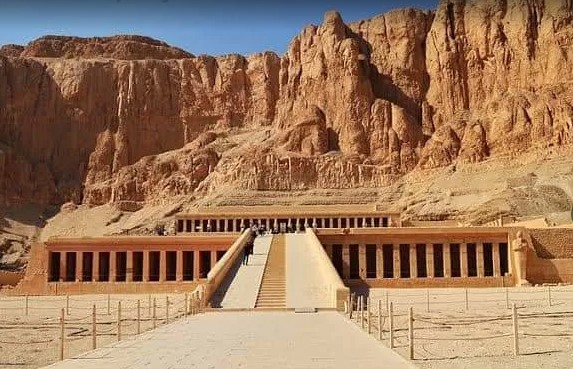
Egypt’s pharaoh Hatshepsut stands out as one of the most powerful women of the ancient world, ruling a peaceful and prosperous Egypt during the 18th Dynasty.
We visited her spectacular terraced mortuary temple at Deir el‑Bahri (Djeser‑Djeseru) on the west bank at Luxor in late 2023 and again in 2025 when we went back with our daughters.
The temple was astounding in its resemblance to something that would be built today. Its symmetry and balance, along with its painted celestial sky, is incredible to see.
Birth and family
Hatshepsut was born around 1507–1504 BCE as the daughter of Pharaoh Thutmose I and his great royal wife, Queen Ahmose, giving her a very strong lineage of royal blood. Her name means “Foremost of Noble Women,” a fitting title for a princess raised in the inner circle of power. Through her mother, a daughter of Pharaoh Ahmose I, she was linked to the founders of the New Kingdom and its renewed strength after the Hyksos were expelled.
Marriage and children
To secure the dynasty, Hatshepsut married her half‑brother Thutmose II, son of Thutmose I by another wife, Mutnofret, a common dynastic strategy meant to protect royal legitimacy. The marriage produced at least one child, a daughter named Neferure, but no surviving sons, which later helped open the door for Hatshepsut’s own rise to the throne. The male heir, Thutmose III, was Thutmose II’s son by a secondary wife, Isis, making him Hatshepsut’s stepson rather than her own child.
Rise to power and reign
When Thutmose II died, the infant Thutmose III technically became king, and Hatshepsut initially ruled as his regent before taking on full pharaonic titles and depicting herself as a king. Her reign lasted about 21 years and was marked by peace, prosperity, and a strong emphasis on trade rather than conquest, including the famous expedition to Punt that brought back luxury goods such as gold and ivory and, famously, live myrrh trees that were planted at Deir el Bahri. She launched an ambitious building program, expanding the great temple of Amun at Karnak and commissioning her incredible terraced mortuary temple at Deir el‑Bahri (Djeser‑Djeseru) on the west bank at Luxor.
Conflicts and challenges
Unlike many pharaohs, Hatshepsut’s rule is not remembered for major military campaigns but for internal consolidation and foreign trade. Her deeper “conflict” was political and ideological -maintaining authority as a female king in a conservative system – which she managed through divine legitimacy, elite support from powerful officials, and highly visible state projects.
Death, burial, and legacy
Hatshepsut likely died around 1458 BCE, perhaps in her late 40s, after which Thutmose III ruled alone. She prepared for burial in tomb KV20 in the Valley of the Kings, planning a double interment with her father Thutmose I, whose tomb she enlarged to emphasize their close bond and her legitimacy.
Later, Thutmose III (or his son Amenhotep II) moved Thutmose I to another tomb and began erasing Hatshepsut’s name from monuments, an attempt to rewrite the royal line so that it ran directly from Thutmose I to II to III without a powerful female king in between. Despite this, her temple, obelisks, and inscriptions survived well enough that today she is celebrated as one of Egypt’s greatest builders and as a trailblazing woman who ruled like a pharaoh in her own right.
How she became pharaoh
When Thutmose II died (c. 1479 BCE) and Thutmose III was still a child, Hatshepsut began as regent. By the end of Thutmose III’s seventh regnal year, she was crowned king, adopted full royal titulary, and ruled as dominant co‑ruler, eventually reigning about 21 years in total.
In official art she moved from queenly imagery to the full visual language of kingship – kilt, crown/headcloth, and the ceremonial false beard – because Egyptian art depicted rulers as they “should be” in their role, not as literal portraits.
How she justified ruling as a woman
Hatshepsut’s reign shows a clear strategy: she framed her rule as divinely sanctioned and understood herself as performing the office of kingship properly. She explicitly claimed the god Amun as her divine father (even portraying him as her father in temple scenes) and insisted she acted under his command, using religion to argue that her accession was the gods’ will rather than a human political improvisation.
In carvings and statues she appeared in the traditional regalia of a male pharaoh – the royal kilt, nemes headcloth, and false beard – because, for Egyptians, kingship was a sacred role with a set visual code, regardless of the person’s biology.
She also relied on loyal, high‑status officials—most famously Senenmut, overseer of royal works and tutor to Neferure—who helped stabilize her government and project authority.
Death, burial, defacement, and mummy
The cause of Hatshepsut’s death is unknown, and earlier theories (including murder or illness) remain unproven. She prepared burial in the Valley of the Kings and even extended her father’s tomb so they could lie together, underscoring her legitimacy through Thutmose I.
After her death, an organized effort removed many traces of her rule – statues torn down, monuments defaced, and her name removed from king lists – often described as a calculated re-editing of history, reshaping the royal ilne so it ran smoothly from Thutmose I to II to III – without a powerful female king interrupting the storyline.
As for her mummy: her body was missing from her sarcophagus when her tomb was excavated in the 1920s, and Britannica notes it has not been conclusively identified.
 ExploreEgypt
Leave a comment