
We visited Karnak twice – once with our group in November 2023 and again on our private trip with our Guide, Egyptologist Fouad Berto, in January 2025.
“Karnac is the history of a race, the greatest race, perhaps, that ever existed…”
Do you know who said that, in a book she wrote about Egypt?
It was Florence Nightingale, in her book published in 1854. She traveled to Egypt in 1849-1850, during the winter months, and kept a detailed journal in her book, “Letters from Egypt”,
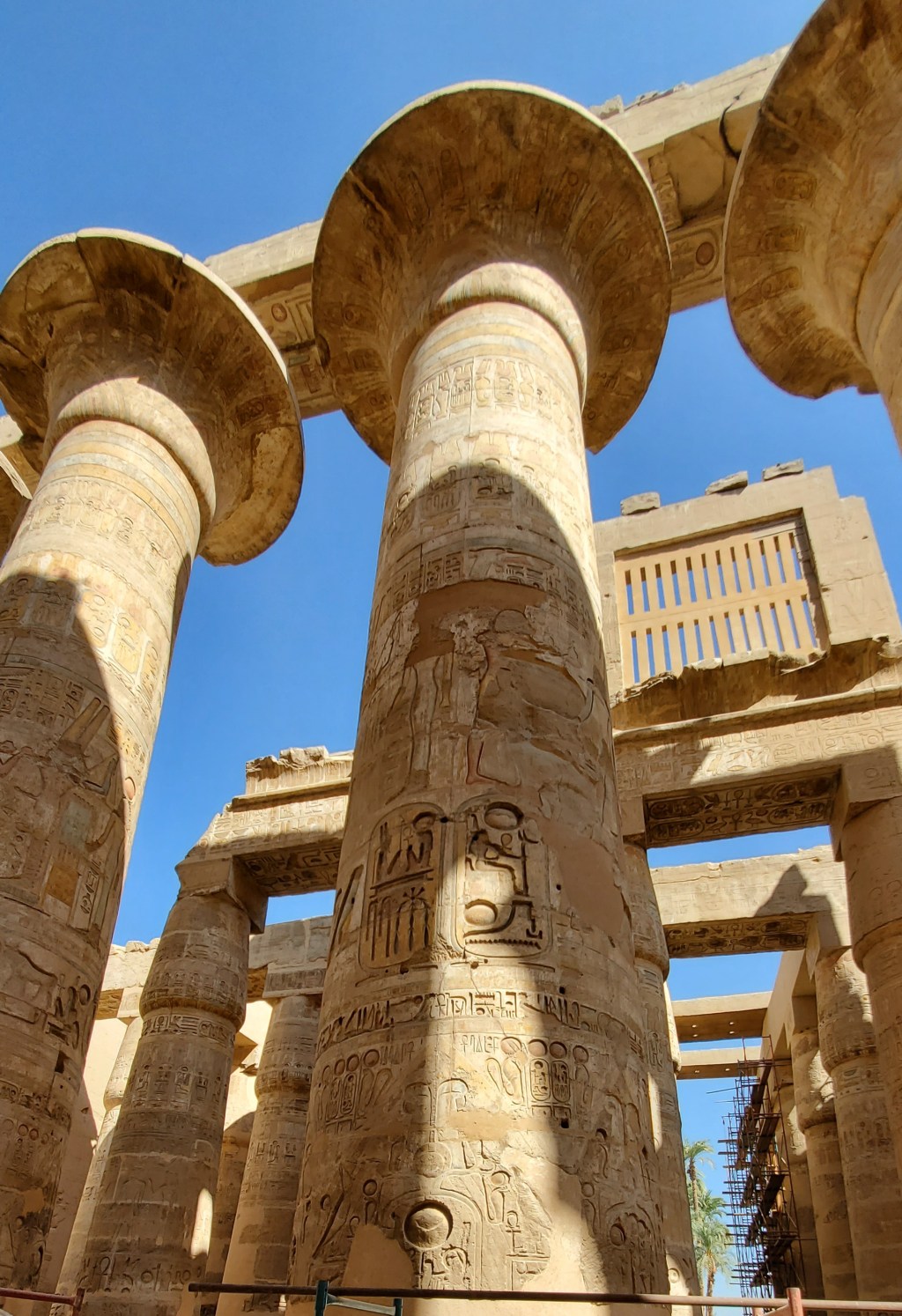
No matter how well-traveled you are, when you walk down the avenue of sphinxes, past the immense, absolutely gigantic columns (which were brightly colored in their day) and look up at the incredible engineering that must have gone into the open-air ceiling structure you just can’t help wondering, HOW??
Karnak is more than a large ancient temple, it’s a vast temple complex, made up of four main parts built over 2,000 years and covering more than 200 acres.
It is believed to be one of the most-visited historical sites in Egypt, second only to the Giza pyramids.
The original name of the temple was Ipet-isut, meaning “The Most Select of Places.” The more modern name, “Karnak” comes from the nearby village of el-Karnak, which means “fortified village.” (Source: https://en.wikipedia.org/wiki/Karnak)
Home of the Gods
It must have been a staggering site to both the ancient Egyptian population as well as any travelers who were invited to see it – it absolutely must have impressed them all as truly the home of the gods.
The Karnak complex is the largest religious site ever conceived, covering about 200 acres (1.5 km by 0.8 km), and was a place of pilgrimage for nearly 2,000 years. The area of the sacred enclosure of Amun-Re alone is sixty-one acres and could hold ten average European cathedrals.
The great temple at the heart of Karnak is so big that St Peter’s, Milan, and Notre Dame Cathedral would fit within its walls.
Although the site is made up of four main sections, visitors enter through the Temple of Amun-Re and most only see the Precinct of Amun-Re because the other three – the Precinct of Mut, the Precinct of Montu and the disassembled Temple of Amenhotep IV, are closed to the public. There are also a few smaller temples and sanctuaries connecting Precincts of Mut, Amun-Re and the Luxor Temple.
The Precinct of Mut is probably the most ancient site at Karnak, being dedicated to an Earth and creation deity, but not yet restored. The original was destroyed and partially restored by Hatshepsut (the female Pharaoh whose monument is astoundingly current-looking and is located near the West bank of the Nile near the Valley of the Kings.
The primary difference between Karnak and most of the other temples and sites in Egypt is the length of time over which it was developed and used. Construction of the temples started in the Middle Kingdom and continued into Ptolemaic times. Approximately thirty pharaohs contributed to the buildings over the centuries, enabling it to reach a size, complexity, and diversity not seen elsewhere.
Few of the individual features of Karnak are unique, but the size and number of features are vast. The deities represented range from some of the earliest worshipped to those worshipped much later in the history of the Ancient Egyptian culture.
Rick Steves has a short video here.
History
The history of the Karnak complex is largely the history of the rise and fall of Thebes (later Luxor) as a major center of Egyptian power and religion and its changing role in Egyptian culture. Religious centers varied by region, and when a new capital of the unified culture was established, the religious centers in that area gained prominence.
Before Thebes became the capital during the New Kingdom, the area had a more modest religious significance, with smaller shrines dedicated to local deities like Mut and Montu. However, with Thebes’ elevation to the capital, the Karnak complex became a massive religious center, with successive pharaohs adding to its grandeur for over 2000 years.
The Great Hypostyle Hall
What do those open and closed papyrus columns symbolize?
At Karnak, the open and closed papyrus capitals on the columns of the Great Hypostyle Hall symbolize the marshlands of the Nile Delta and, by extension, creation and the origin of life. The open capitals, resembling blooming papyrus flowers, represent the abundance and flourishing nature of the marsh, while the closed capitals, resembling buds, suggest potential and new beginnings.
Papyrus as a Symbol:
The papyrus plant, prevalent in the Nile Delta, was a significant symbol for ancient Egyptians, representing Lower Egypt and fertility.
Open Capitals:
The large, open capitals of the central columns in the Great Hypostyle Hall are designed to resemble the open, bell-shaped flower of the papyrus plant in bloom. This imagery evokes a sense of abundance, growth, and the fertile marshlands where the papyrus thrived.
Closed Capitals:
The smaller columns flanking the central nave have closed, bud-like capitals, suggesting the papyrus plant in its early stages of growth. This imagery can be interpreted as representing potential, new beginnings, and the ongoing cycle of life.
Marsh as a Metaphor:
The marshlands of the Nile were vital to ancient Egyptian civilization, providing resources like papyrus and playing a crucial role in agriculture and the origin of life. The representation of papyrus in the temple architecture reinforces this connection to the natural world and its significance in creation.
Overall Symbolism:
By incorporating both open and closed papyrus capitals, the temple design encapsulates the full cycle of life, from budding potential to flourishing abundance, all within the context of the life-giving Nile and its fertile marshlands.
Source, partial: https://www.memphis.edu/hypostyle/tour_hall/great_columns.php)
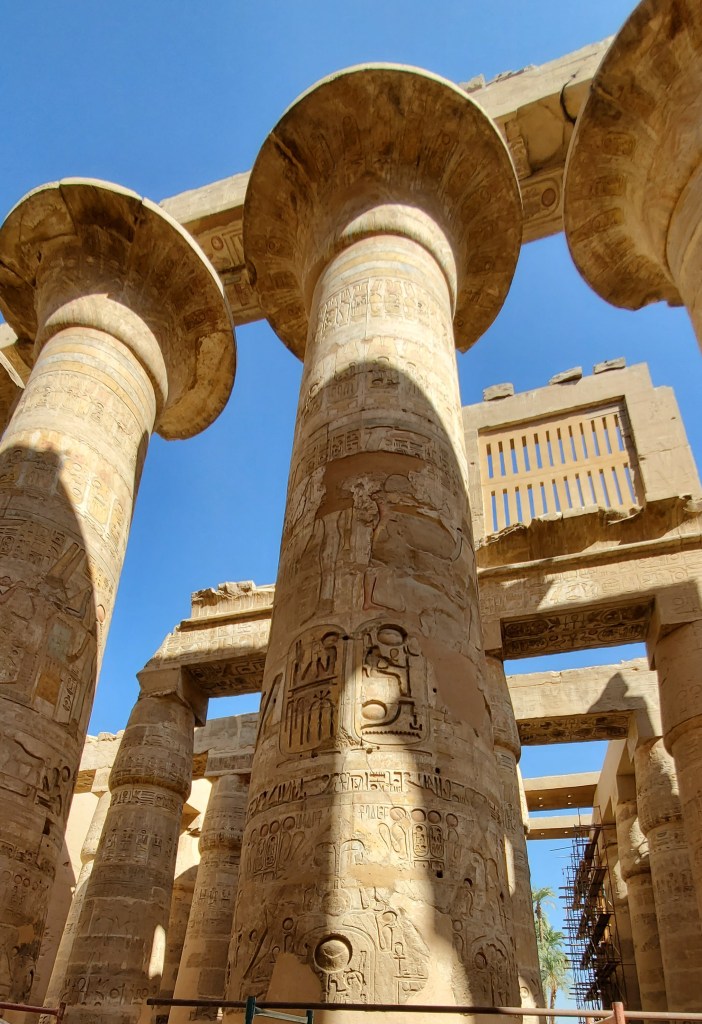
Open papyrus umbel capitals and architrave on the central columns of the Hypostyle Hall. (Credit: Susan Serven)
Closed papyrus umbel capitals of the Hypostyle Hall.
Highlights:
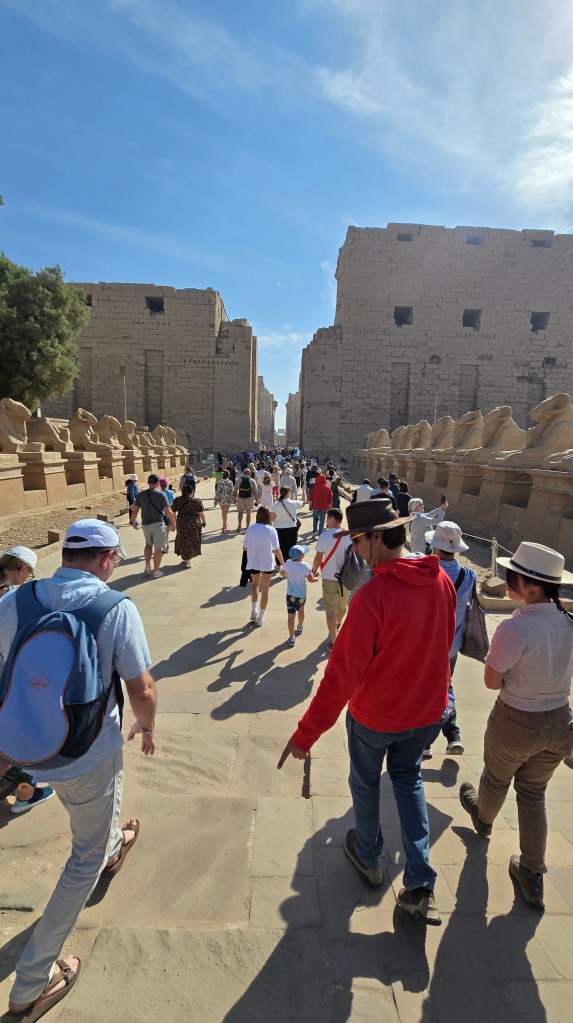
Egyptologist Fouad Berto at the entrance to Karnak Temple.
The Temple of Amun-Re
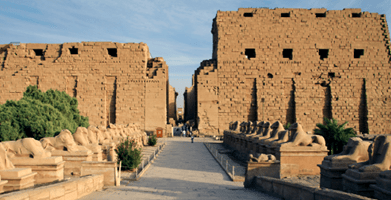
As mentioned above, the massive temple complex of Karnak was the principal religious center of the god Amun-Re in Thebes during the New Kingdom (which lasted from 1550 until 1070 B.C.E.). The complex remains one of the largest religious complexes in the world, however. Karnak was not just one temple dedicated to one god—it held not only the main precinct to the god Amun-Re—but also the precincts of the gods Mut and Montu.
Above is a view of the first pylon of the temple of Amun-Re at Karnak which is how you enter the site.
The Second Pylon
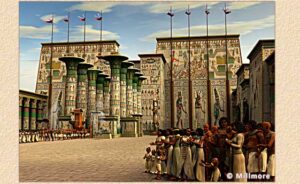
Before the later Shoshenq court* is the second pylon. It was built by Horemheb (1323-1295 B.C.) who filled the interior of the pylon with thousands of stone blocks from demolished monuments built by the Heretic king, Akhenaten. But it was unfinished and only partly decorated at his death. Ramesses I later completed the decoration and replaced all of Horemheb’s cartouches with his own and it was again usurped by his grandson Ramesses II. Today the second pylon’s outer wall is severely damaged and its original height is unknown.
* This court refers to a significant construction project undertaken by Shoshenq I, the founder of the 22nd Dynasty of Egypt, at Karnak. It refers to the Bubastite Portal, a large court and pylon (monumental gateway) located before the second pylon at Karnak.
The Hypostyle Hall, at 54,000 square feet (16,459 meters) and featuring 134 columns arranged in 16 rows, is still the largest room of any religious building in the world. One hundred and twenty-two of these columns are 33 feet (10 meters) tall, and the other 12 are 69 feet (21 meters) tall with a diameter of nearly 10 feet (3+ meters). The architraves, on top of these columns, are estimated to weigh 70 tons.
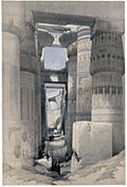
Hypostyle hall of the Precinct of Amun-Re, as it appeared in 1838 in “The Holy Land, Syria, Idumea, Arabia, Egypt, and Nubia.”
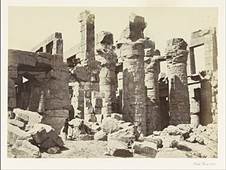
The Great Hypostyle Hall (1857, Rijksmuseum, The Netherlands)
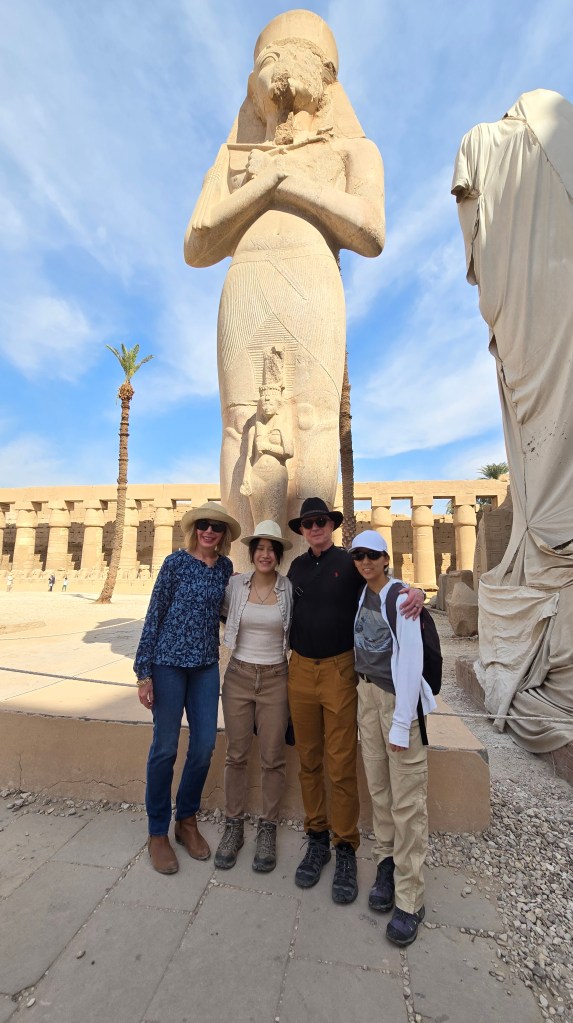
The second pylon was fronted by two striding colossi of Ramesses II, of which only the feet of one remain.
In front of these is a third, standing statue of the king -with the diminutive figure of the princess Bent’anta standing between his feet. (Credit: Fouad Berto)
The Sacred Lake of the Precinct of Amun-Re
Besides the main sanctuary, there are several smaller temples and a vast sacred lake – 423 feet by 252 feet (129 by 77 meters). The sacred barges of the Theban Triad once floated on the lake during the annual Opet festival. The lake was surrounded by storerooms and living quarters for the priests, along with an aviary for aquatic birds.
The Kheper Scarab at Karnak
The Kheper Scarab at Karnak Temple that people walk around is a large statue of a scarab beetle, also known as the Colossal Khepri statue. It’s located near the Sacred Lake and is associated with the ancient Egyptian god Khepri, who is linked to Ra, the rising sun and rebirth. Visitors often walk around the statue, a practice believed to bring good luck, attract love, or fulfill wishes.
Three out of the four of us walked around the Kheper Scarab and we’ve had a lot of good luck since then, so I’d say it works.
Osirid statues of Thutmose I
Osirid statues of Thutmose I at the Amun-Re temple in Karnak (in the Wadjet Hall). The head of the statue on the right of the image was removed in modern times and is currently located at the British Museum
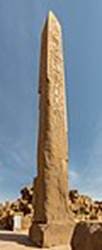
Obelisk of Thutmosis I in Karnak
Luxor Dromos, the Avenue of Sphinxes
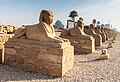
The Luxor Dromos, or Avenue of Sphinxes, is a 1.7 mile (2.7 km) long avenue (dromos) of human-headed sphinxes which once connected the temples of Karnak and Luxor (and was re-opened to the public in November 2021 after extensive restoration).


.jpg)


Leave a Reply