
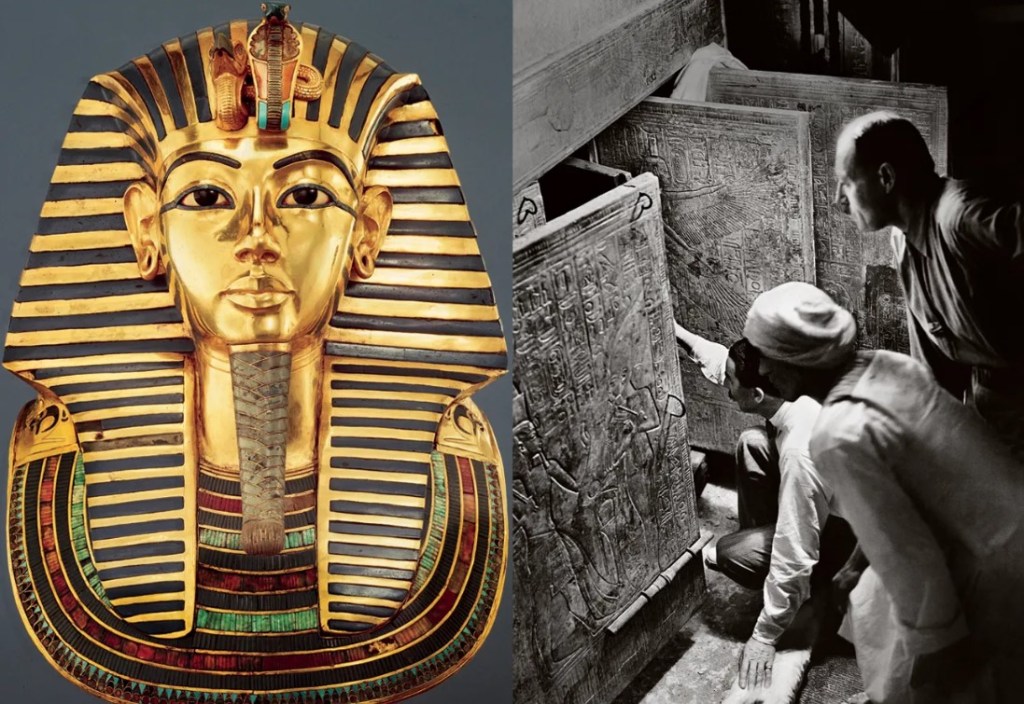
Despite the “boy king” Tutankhamun’s importance in our history today, his reign was a short and relatively inconsequential one in ancient Egypt.
Tutankhamun who changed his name from Tutankhaten (which means “Living Image of the Aten”) to Tutankhamun (“Living Image of the Amun”) was a New Kingdom pharaoh who became king around age nine, after the death of his father.
His rule, from about 1332–1323 BCE until his own death at around age 19, was a time of war with neighboring kingdoms like Nubia and the Asiatics.
He was born with a clubfoot and was sickly, using a walking stick and eventually dying at about age 19, likely from malaria and a broken leg (possibly from a fall from a chariot since there was damage to his skull as well, which could also have been caused by mummification or damage during excavation).
He became famous in death
due to the discover of his nearly intact tomb by archaeologist Howard Carter, in November 1922. His tomb revealed incredible treasures and provided immense insight into ancient Egyptian life. Artifacts included objects made of gold, lapis lazuli, carnelian, and other gems which astounded the world then, and still does, today.
However, few know of his biggest achievement in life
He restored the worship of traditional gods, particularly that of Amun-Ra, and returned Egypt to polytheism. This overturned the religious reforms of his father, Akhenaten, ending the Atenism his father had imposed.
After his father Akhenaten’s death, the capital Akhenaten founded at Amarna, was abandoned so Tutankhamun moved his family and many deceased relatives’ remains (including his father’s) from Akhetaten (modern Amarna) to Thebes (modern Luxor).
His father’s remains were located in the Royal Tomb of the Valley of the Kings, known as KV55. However, he was defiled there; his sarcophagus was damaged, and his name was removed resulting in the eventual final move of Akhenaten’s remains to a different tomb, unknown today.
The boy king wasn’t ruling entirely on his own, however, he was guided by several key figures including Ay, the Grand Vizier and potentially Tut’s maternal grandfather, and Horemheb, the commander-in -chief of the military.
After his death, he was mummified and buried in his tomb at the Valley of the Kings, until his tomb’s discovery in 1922 as mentioned above. His tomb remains intact at the Valley of the Kings, but the items found with him have recently (November 1, 2025) been moved from the 1902 Egyptian Museum in Cairo to the Grand Egyptian Museum, at Giza, near the pyramids.
His successor was his vizier, Ay.
PBS has a very good documentary on King Tutankhamun and his family, info is here.


Leave a Reply