
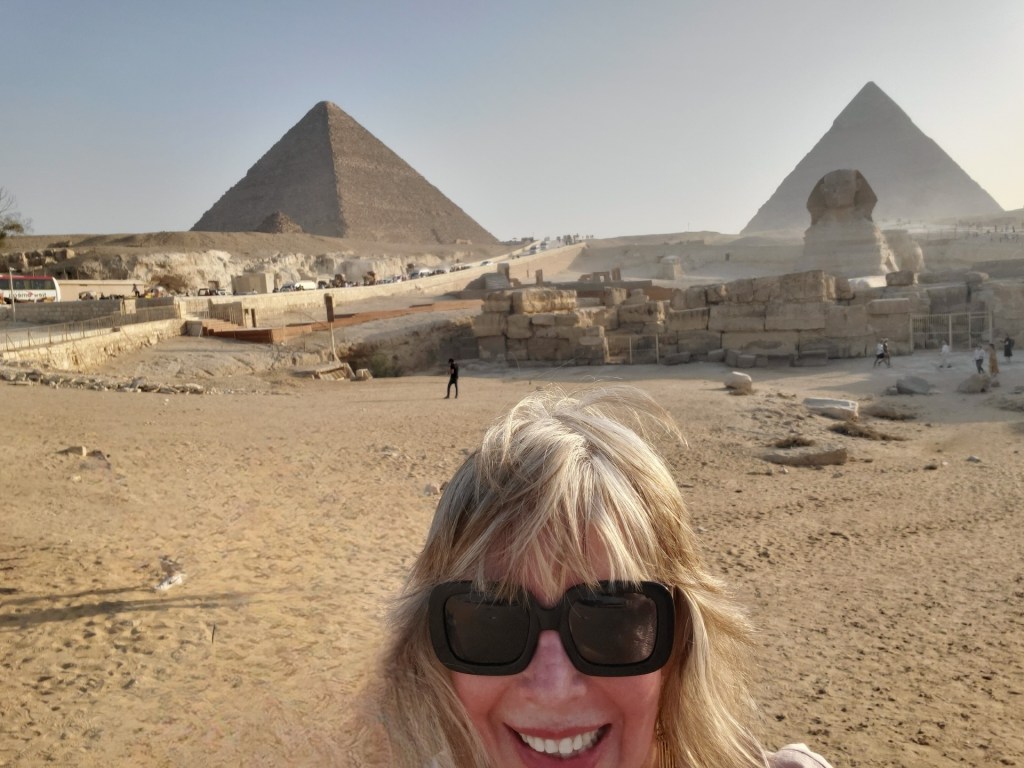
A big birthday was fast approaching for me, no plans had been made for a trip (much better than a birthday party, IMHO) so after checking with my husband, “Have you made any plans for my birthday yet?” “No, I have it on my list,” I took up the challenge myself and narrowed my Wish List down to three birthday celebrations – a 12-day trip to India (you need more time to see India so better to wait), a photo-safari in Africa (Botswana or Kenya) or a Nile River Cruise in Egypt.
My husband wasn’t crazy about the first two choices, so Egypt it was.
I had forgotten, until just very recently, that we had actually scheduled a cruise to Egypt, years ago, for New Year’s Eve 1999 (remember Y2K??). The itinerary was changed to a Portugal, Spain, Gibraltar and Morocco trip for some reason (probably a political skirmish or something, but I distinctly remember being annoyed because in my younger mind, “there was nothing going on, no reason to change”).
But things happen for a reason and if we had gone back then I would not have gone in 2023, so there you go.
Initially I was a little nervous – not about the trip itself (although the Gaza war had just started 3 weeks before we were scheduled to go – so all we heard was, “you’re still GOING?!”) – but whether I’d be interested enough for the 12-day trip. I really wanted to see the pyramids and especially the Sphinx, and I had read up on much of the (incredibly extensive multi-millennia) history, but would it be too much after a few days, would the multiple cities and temples overwhelm me after a while? I’m not an archaeologist, after all.
I had nothing to worry about.
You can do all the reading you want – watch Death on the Nile (I didn’t, I don’t like Agatha Christie, don’t hate me) and many, many NatGeo and Ancient Civilization documentaries, but nothing, NOTHING, will prepare you for the astonishing breathe of history, mystery (“how DID they build those pyramids / move those 40 ton blocks / create the early writing system of hieroglyphics / develop such a deep understanding of the math, geometry, architecture, and knowledge of the cosmos to be able to map much of their architecture to the stars of thousands of years ago?”) and unending number of things to see in this welcoming, fascinating country.
I was astounded at the innovations:
- Writing – the complex series of writing hieroglyphics was developed around 3,000 BCE
- Astronomy – they cataloged stars, most likely discovered “variable” stars,” mapped constellations, tracked the movements of celestial bodies like the sun and moon, and aligned much of their architecture to the cosmos
- Calendar – created the concept of a 365-day calendar used to predict the Nile’s flooding and plan agriculture
- Mathematics – development of the base 10 number systems and expanded use of geometry and quadratic equations
- Medical – they invented surgical instruments and prosthetics among other things
- Irrigation – Egyptians developed agricultural irrigation systems to make use of the Nile for farming
- Clocks – the first timekeeping devices, used to track the sun’s movement across the time, were developed by Egyptians
- Paper – the Egyptians were the first to use papyrus as a writing material
And I was especially delighted to experience the hospitality and feel the friendliness and warmth of Egypt’s openhearted, expressive, welcoming people (who mostly also have a great sense of humor).
We spent an incredible 12 days on this trip, and my heart was breaking when it was time to leave.
I felt as if I had recognized a home I had forgotten, a people and a culture I loved, and I longed to return.
If you’ve read this far, thank you for your patience, and please stick with me as we explore Egypt together!

 ExploreEgypt
Leave a reply to The Serapeum of Saqqara, Tomb of the Sacred Apis Bulls – ExploreEgypt Cancel reply