On my first trip, I didn’t understand why we were going to Saqqara, about 25 miles (40km) southwest of Cairo, first, before the pyramids, Sphinx or any other archeological sites.
But it became pretty clear once we walked across the vast grounds of the Saqqara Necropolis to the Monument of King Unas, located just south of the Step Pyramid of Djoser, that this was the perfect starting point to see the evolution of Egypt’s pyramids.
Unas, King of Southern and Northern Egypt, reigned for 15 to 30 years in the mid-24th century BCE, around 2,320 BCE. He was the ninth and last ruler of the Fifth Dynasty of Egypt during the Old Kingdom.
The Pyramid of Unas is primarily a tomb, designed as the final resting place for Pharaoh Unas. However, it also functions as a monument due to its historical significance and the inclusion of the Pyramid Texts within his burial chamber, marking a significant development in ancient Egyptian funerary customs.
The pyramid is part of a larger complex that includes a mortuary temple, causeway, and valley temple, all contributing to its role as a funerary complex and a monument.
What are the Pyramid Texts?
The Pyramid Texts are the oldest surviving collection of Egypt’s religious literature, made up mainly of prayers, hymns and rituals developed and accumulated over generations. The earliest examples of carving these texts in stone come from Unas’ tomb.
(There are a total of 759 spells known to date, though not all of them are found in the same pyramid; Unas’ pyramid, for example, contains 228.)
The Pyramid Texts are not specifically a “story” of Pharaoh Unas’s journey after death, but rather a collection of funerary spells, incantations, and religious texts inscribed on the walls of his pyramid (and other pyramids of the 5th and 6th Dynasties). These texts are among the oldest known religious writings in the world, dating to around circa 2350 BCE.
Some background
Unas was the King of both Southern and Northern Egypt. In a religious sense he was not just a king, he was also a god. While alive here on Earth he was represented as Horus, the one who is aloft, the Sky God, the Eternal King of Humanity.
After death, the King transformed from Horus to Osiris, and became Osiris The Powerful or The Mighty One, so the Pyramid Texts regularly address Unas as both Horus and Osiris.
After he died, the belief was that the deceased would travel to the afterlife, somewhere beyond the western horizon, to leave our world and enter the next.
However, Unas has another destination to travel to. First, the king’s soul would journey to the north and up to the sky. The sky is the realm of the kings, the great King Atum, the One Who Is Complete, Ra, the Sun, Horus the One Who Is Aloft, Nut, the Sky itself, and many others besides. Unas as a dead king is invited to join other gods in that celestial realm.
Here’s how they relate to Unas and his afterlife
In the Pyramid of Unas (the first known pyramid to feature these texts), the spells are tailored to his specific burial and hoped-for afterlife. They invoke gods, describe rituals, and articulate beliefs about the journey of the pharaoh’s soul through the underworld to become an immortal, divine being.
Purpose of the Pyramid Texts
The texts were meant to guide and protect the deceased king in the afterlife, helping him:
- Ascend to the sky,
- Join the sun god Ra or become a star,
- Avoid dangers in the Duat (the Egyptian underworld),
- Be resurrected and live eternally among the gods.
- How can I visit King Unas’ Pyramid:
When we visited, the tomb is partially collapsed, but an entrance is easily accessible via a ramp down into the tomb. After a short descent (not easy if you’re tall, you’ll have to crouch, some find it easier to go in backwards) you’ll arrive at the antechamber.
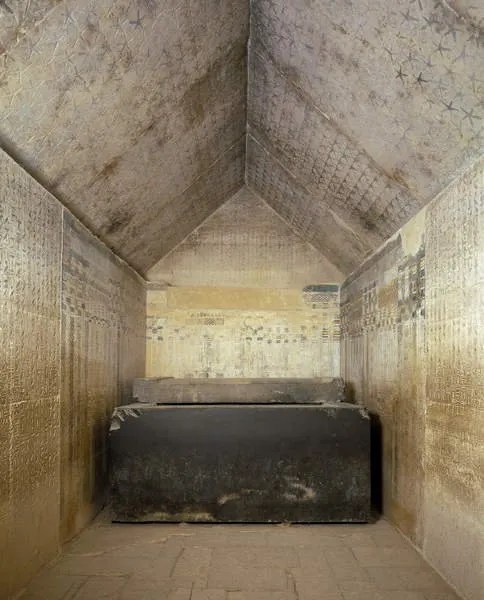
To the east of the antechamber opens a small room with 3 recesses, sometimes described as magazines or as statue niches. Opposite the magazines, to the West of the antechamber lies the Burial chamber, with its basalt sarcophagus still in place, surrounded by floor to ceiling hieroglyphs of the Pyramid Texts.
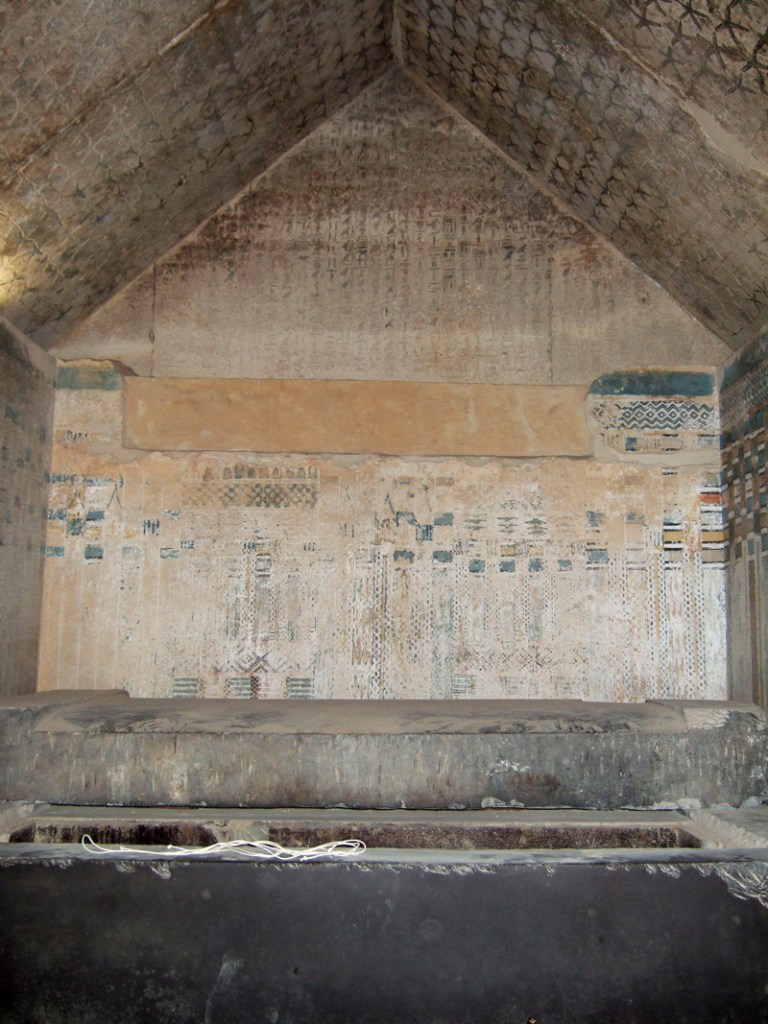
The burial chamber with protective spells filling the west gable, protecting the sarcophagus and its contents below. Sarcophagus of Unas.
The three walls surrounding the sarcophagus are the only area inside the pyramid that is not inscribed with texts (barring the first section of the entrance passage). Instead, the false door motif or palace facade surrounds the sarcophagus.
Above the sarcophagus on the gabled western wall, however, are some rather enigmatic spells designed to protect the body of Unas below them.
“The fire has been extinguished, no lamp can be found in the house where the Ombite is.
The biting snake is all over the house of the one he would bite, hiding in it. “
Utterance 242.
By Vincent Brown – https://www.flickr.com/photos/pyramidtexts/6242701386, CC BY 2.0, https://commons.wikimedia.org/w/index.php?curid=74814627
How were those hieroglyphs so perfectly carved in the tomb, from ceiling to floor? How was that immense sarcophagus moved in any way, much less placed so perfectly (even if the pyramid was built around the sarcophagus, it’s still an incredible feat of engineering). How did they even CARVE OUT the sarcophagus – even our diamond tips drill bits would have a hard time making a dent in it.
Who knows?
But there are two great sites I’ve found…
One is a list of several podcasts in a series which lists detail and full readings and translations of the Pyramid Texts, the other is a written translation in English, by wall, of the Pyramid Texts.
A perfect, and fascinating place to begin your Pyramid Journey.

 ExploreEgypt
Leave a reply to Memphis, Ancient Seat of Power – ExploreEgypt Cancel reply