
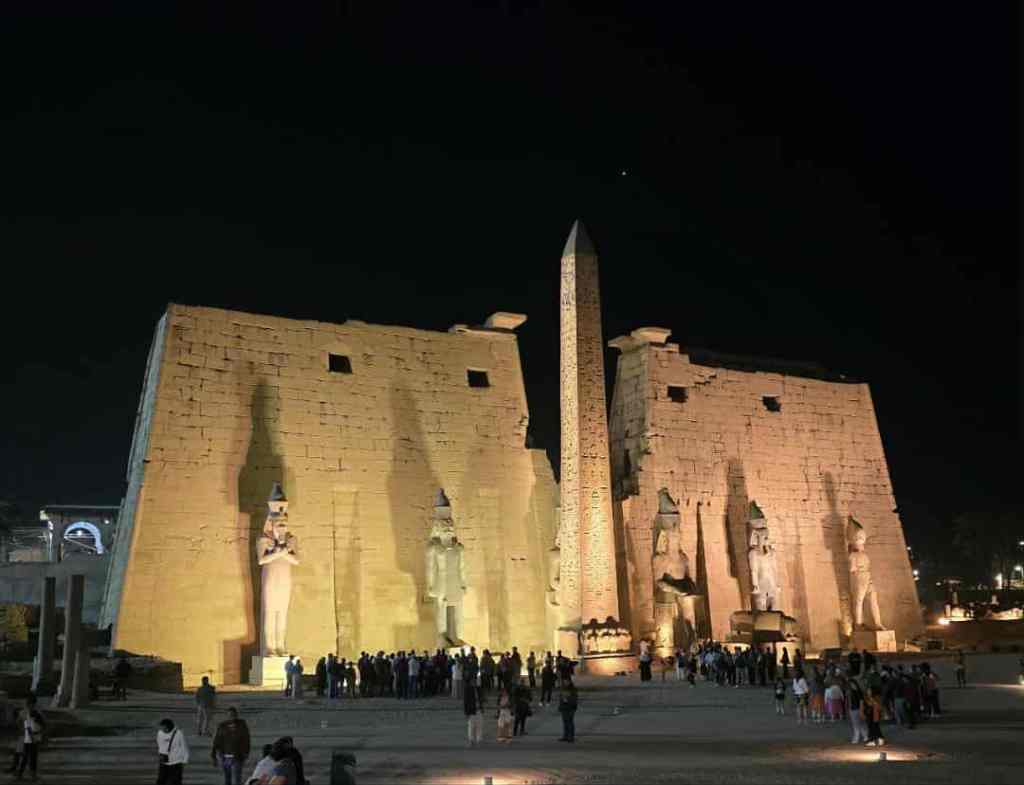
Numerous books and documentaries have been written about the incredible Temple of Luxor, located in the city of Luxor (formerly Thebes), but nothing can prepare you for seeing it in person. The site teems with living energy and nobility.
The city of Luxor is famous due to its role as the ancient capital of the New Empire during the Middle Kingdom (2055–1650 BCE) and through the height of the New Kingdom (approximately 1550–1070 BCE), where it flourished as the political and religious center of the empire.
The Temple of Luxor is considered the second largest temple in Egypt after the Temple of Karnak.
One of the most spectacular ways to see it is at night. It’s very moving to go before sundown and experience it as the day is waning and night is descending.
The complex is lit up at night until it closes about 10pm.
The Temple, located on the east bank of the Nile River in Luxor (ancient Thebes), is a large ancient Egyptian temple complex dating back to around 1400 BCE. Unlike other temples in Thebes, Luxor Temple is not dedicated to a cult god or a deified version of the pharaoh in death. Instead, it is dedicated to the rejuvenation of kingship; it may have been where many of the kings of Egypt were crowned.
According to the Ministry 0f Tourism and Antiquities,
Luxor Temple, (known as) Ipet-resyt “Southern Sanctuary” to the ancient Egyptians, was so called because of its location within ancient Thebes (modern Luxor). It is located around three kilometers to the south of Karnak Temple, to which it was once linked with a processional way bordered with sphinxes. The oldest evidence for this temple dates to the Eighteenth Dynasty (c.1550–1295 BC).
Ipet-resyt, unlike most other ancient Egyptian temples, is not laid out on an east-west axis, but is oriented towards Karnak. This is because Luxor Temple was the main venue for one the most important of ancient Egyptian religious celebrations, when the cult images of Amun, his wife Mut, and their son, the lunar god Khonsu, were taken from their temples in Karnak, and transported in a grand procession to Luxor Temple so they could visit the god that resides there, Amenemopet. This was the Opet Festival.
Luxor Temple was not built by one single ruler. The oldest existing structure, a shrine, dates to the reign of Hatshepsut (c.1473–1458 BC). The core of the temple was built by Amenhotep III (c.1390–1352 BC).
One of the inner rooms contains a series of scenes that are known as the Divine Birth. They tell the amazing story of how the king’s true father was none other than the god Amun-Ra himself, disguised as Thutmose IV (c.1400–1390 BC). The core of the temple is preceded by a columned hall fronted by a courtyard with columns around its perimeter. Amenhotep III also built the Great Colonnade, which consists of two rows of seven colossal columns. Its decoration, most notably the scenes depicting the Opet Festival, were completed by Tutankhamun (c.1336–1327 BC) and Horemheb (c.1323–1295 BC).
Ramesses II (c.1279–1213 BC) made many additions to Luxor Temple. In front of the Great Colonnade, he built a peristyle courtyard and a massive pylon, a gate with two towers that formed the entrance into temples. In addition to many colossal statues, the pylon was also fronted by a pair of 25-meter-high obelisks made by this great king, but only one remains in place; the other has been at the Place de la Concorde in Paris since 1836.
In the late third century AD, the Romans built a fort around the temple, and the first room beyond the hypostyle hall of Amenhotep III became its sanctuary. The original wall reliefs were covered with plaster, and painted in the Graeco-Roman artistic style, depicting Emperor Diocletian (284–305 AD) and his three coregents. Although these had largely disappeared, efforts are under way to restore these reliefs to their former glory.
Key Architectural Features:
The temple complex is notable for its massive pylon (gateway) built by Ramesses II. The pylon is decorated with scenes of Ramses’ military expeditions, particularly his victory at the Battle of Kadesh.
The Avenue of Sphinxes, a ceremonial road flanked by sphinx statues, once connected Luxor Temple to Karnak Temple, another major temple complex in Thebes. You can still see remains of the Avenue of Sphinxes when you tour Karnak and it’s a great idea to walk the entire avenue (2.7km) in the early morning or at night. (You will likely need to purchase tickets to both sites, and guided tours are available especially online.)
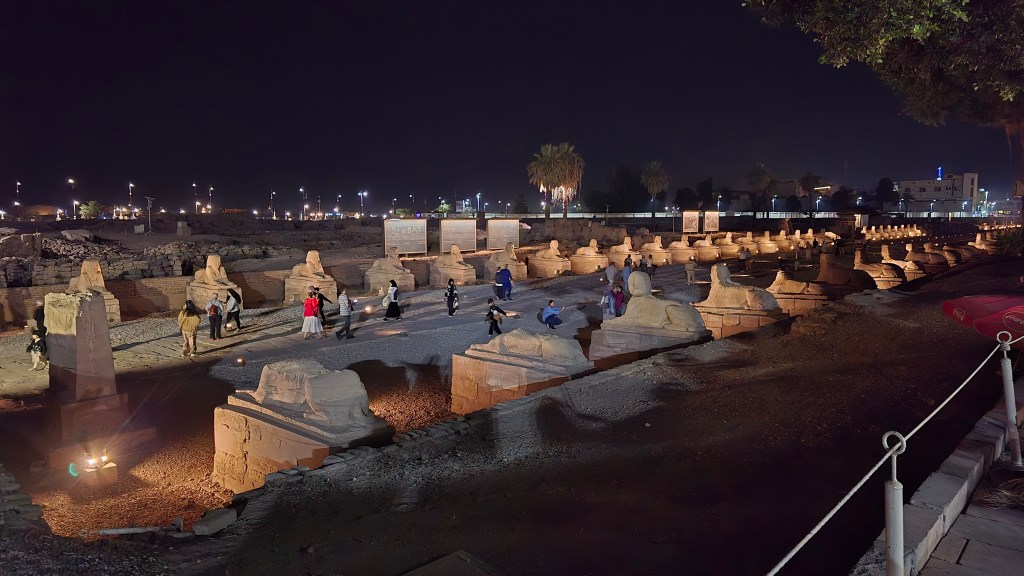
The Avenue of Sphinxes at night.
Significant Structures:
Hypostyle Hall: A large hall with numerous columns, built by Amenhotep III.
Courtyards: The Peristyle Courtyard of Amenhotep III and the Sun Court of Ramses II are two key open-air courts within the temple.
Sanctuary: The innermost part of the temple contains a sanctuary dedicated to the Theban Triad of Amun, Mut, and Khonsu.
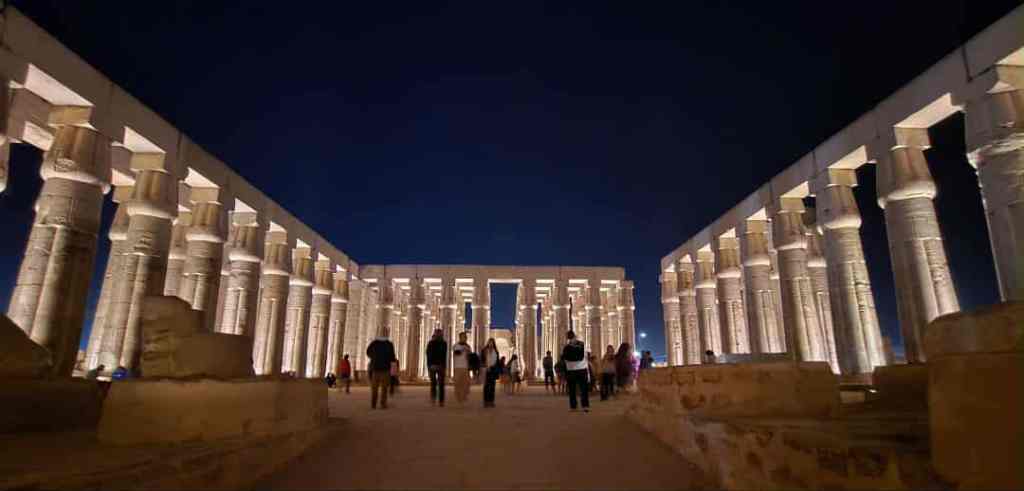
Hypostyle Hall at the Temple of Luxor.
Religious Significance:
Luxor Temple was a focal point for the annual Opet Festival, a celebration that involved the procession of statues of the gods from Karnak to Luxor Temple, symbolizing the divine rejuvenation of the pharaoh.
Roman and Later Periods:
During the Roman period, the temple and its surroundings were incorporated into a fortress and a Roman legionary base.
A chapel built by Alexander the Great and a shrine of Serapis were added during later periods.
Modern Discoveries:
Excavations in the 19th and 20th centuries have revealed much about the temple’s structure and use. The discovery of numerous statues, sphinxes, and inscriptions has provided insight into the temple’s history and the religious practices associated with it.
Interesting Facts:
The temple was used continuously throughout the history of Egypt, with evidence of its use during the Christian era when parts of the temple were converted into a church.
The mosque of Abu Haggag, which dates back to the 13th century, was built within the temple complex and is still in use today.
Luxor Temple remains one of the best-preserved and most important archaeological sites in Egypt, offering a glimpse into the grandeur of ancient Thebes and the religious practices of ancient Egyptians.
Cultural and Religious Influence:
Opet Festival: During the Opet Festival, the statues of the Theban Triad were carried from Karnak to Luxor Temple, linking the two religious sites and reinforcing their significance. This festival was a major event in the ancient Egyptian calendar, highlighting the temple’s importance in the religious life of the society.
Modern Legacy: The mosque of Abu Haggag, built within the temple complex, exemplifies the blending of ancient and modern religious practices, making the Luxor Temple a unique symbol of historical continuity.
The Restoration and Conservation of Luxor Temple:
The preservation of Luxor Temple has been a priority for archaeologists and conservationists.
The temple has experienced water erosion from a rising water table partially caused by modern farming practices, particularly flood irrigation and poor water disposal systems that lead to salt accumulation in the sandstone and limestone structures, and reuse of materials.
In ancient times, many of the temple’s sidewalls were torn down after the time of the pharaohs and recycled for building materials. Over time, salt-laden groundwater began leaching into the stone and causing damage.
After excavations in the 1960s, exposure to changes in humidity accelerated deterioration even further.
The groundwater carries salts, which, when drawn into the stone, crystallize and exert pressure, causing flaking, granular disintegration, and other forms of physical and chemical weathering.
Over the years, various restoration projects have been undertaken to protect and restore the temple’s structures and artwork. These efforts have included cleaning and stabilizing the stone surfaces, repairing damaged reliefs, and reconstructing fallen columns.
Modern technology, such as 3D scanning and digital mapping, has also been employed to document the temple’s condition and plan conservation strategies. The ongoing work to preserve Luxor Temple ensures that this ancient marvel continues to inspire and educate future generations about Egypt’s rich cultural heritage.
Luxor Temple is listed as a UNESCO World Heritage site for its outstanding universal value.


Leave a Reply