
To accomplish this magical regeneration, the Opet festival was held yearly at Karnak and Luxor.
It lasted for twenty-seven days and was also a celebration of the link between pharaoh and the god Amun. The procession began at Karnak and ended at Luxor Temple, one and a half miles (2.4 kilometers) to the south.
The Opet Festival served both a religious and political purpose. The celebration honored the Theban triad, the three gods who were the main objects of worship in the area of Thebes. Known today as Luxor, Thebes was the capital city of the New Kingdom and home to some of the most famous ancient temples and tombs, such as the Valley of the Kings.
The triad, or holy family, was made up of Amun, his partner Mut (considered the creator of the world), and their son Khonsu.
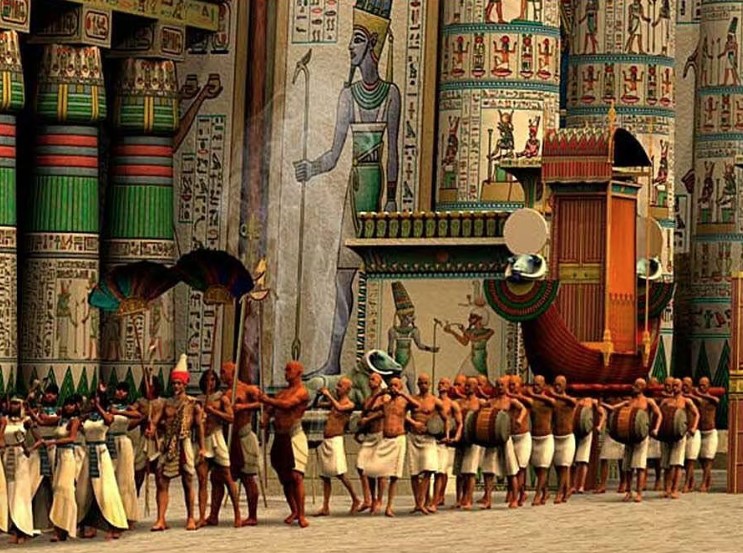
The statue of the god Amun was bathed with holy water, dressed in fine linen, and adorned in gold and silver jewelry. The priests then placed the god in a shrine and onto the ceremonial barque supported by poles for carrying.
The festival’s length varied, starting with 11 days and expanding to 27 days by the time of Ramses II, and was a powerful symbol of the pharaoh’s connection to the divine and the cyclical nature of life, death, and rebirth.
Pharaoh emerged from the temple, his priests carrying the barque on their shoulders, and together they moved into the crowded streets. A troop of Nubian soldiers serving as guards beat their drums, and musicians accompanied the priests in song as incense filled the air.
The purpose of the Opet Festival
At Luxor, Pharaoh and his priests entered the temple and ceremonies were performed to regenerate Amun, recreate the cosmos and transfer Amun’s power to Pharaoh. When he finally emerged from the temple sanctuary, the vast crowds cheered him and celebrated the guaranteed fertility of the earth and the expectation of abundant harvests.
During the festival, the people were given over 11000 loaves of bread and over 385 jars of beer, and some were allowed into the temple to ask questions of the god. The priests spoke the answers through a concealed window high in the wall, or from inside hollow statues.
Amun was a major Egyptian deity who was known since the Old Kingdom, but only became the patron god of Thebes in the 11th Dynasty (21st Century BC). He was associated with the wind and often represented with rams’ horns or two tall feathers.
In the ancient Egyptian pantheon, gods often evolved over time, combining with other gods or taking on new characteristics. In the New Kingdom, Amun became associated with the sun god, Ra, and became Amun-Ra or Amun-re. The first kings of the New Kingdom also credited Amun for their victory over the Hyksos and Amun became a symbol of justice, truth, and a champion of the underprivileged.
 ExploreEgypt
Leave a comment