
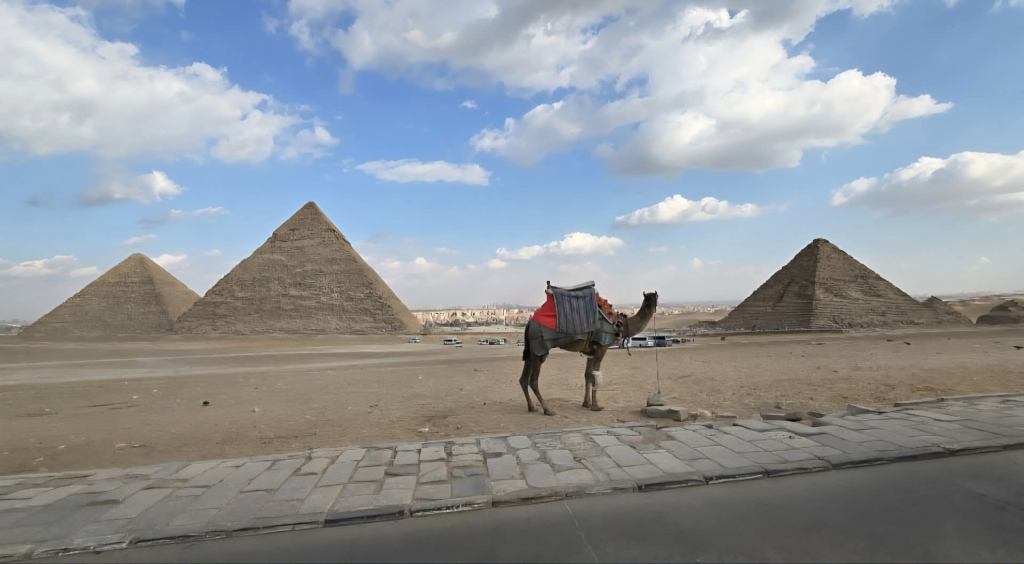
What more can anyone say about the Pyramids?
Even having seen them twice (soon to be three times!!) there’s so much ancient majesty, myth and magic about these colossal structures it seems somehow inappropriate to summarize them in any way.
But I wanted to try.
The Pyramids of Giza are a monumental complex built in ancient Egypt about 4,500 years ago, with the Great Pyramid of Khufu as the largest and most famous of the three. It originally stood about 146.6 meters, or 481 feet, tall, had a base length of about 230.3 meters, or 755 feet, on each side, and was built from an estimated 2.3 million stone blocks.
In ancient times they were covered in sparkling white limestone with a capstone, known as a pyramidion, which were made of limestone, sandstone, basalt or granite. Some may have been covered with plates of copper, gold or a naturally occurring alloy of gold and silver known as electrum.
They were constructed with such precision that even today you can’t slide a credit card between any two stones. Subsequent structures were never able to achieve their architectural accuracy or internal feats of engineering skill.
Size and age
The Great Pyramid’s height has been reduced over time because much of its outer casing stone was removed, so today it stands closer to 138 to 139 meters, or about 454 to 455 feet tall. The structure dates to around 2580 to 2550 BCE, placing it in Egypt’s Fourth Dynasty and making it more than 4,500 years old. Its precise construction and enormous scale made it the tallest human-made structure in the world for more than 3,800 years.
Construction materials
The pyramid was assembled from roughly 2.3 million blocks, mostly limestone, with granite used in important interior areas such as the burial chamber. Scholars estimate the total mass at about 5.75 to 6 million tons. The outer surface originally had polished white limestone casing stones, which would have made the pyramid shine brightly in the sun.
But, what’s inside?
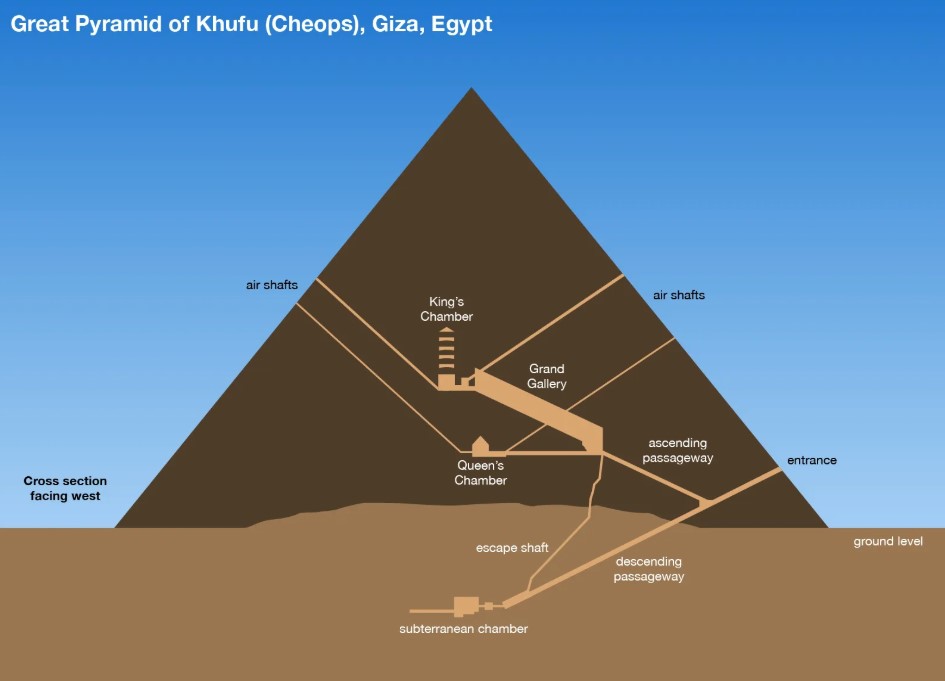
Inside are several major features: the descending passage, ascending passage, the Grand Gallery, the Queen’s Chamber, the King’s Chamber, and a subterranean chamber. The King’s Chamber is built with large granite blocks, while some other internal spaces were cut into or through the limestone core. The chambers and passages are part of why the pyramid has remained one of the most studied structures in the ancient world.
Why did they build them?
The pyramid contains a network of internal passages and shafts that, if measured together, amount to roughly a mile of passageways when broader tunnels and explored internal corridors are counted across the Giza complex and related systems often discussed in popular accounts; the exact total depends on what is included. The commonly accepted purpose of the Great Pyramid was as a royal tomb for Pharaoh Khufu, though it also likely had strong religious and political meaning tied to kingship and the afterlife. Some theories suggest ceremonial or symbolic functions beyond burial, but the tomb function is the mainstream historical view.
Star alignment
The pyramids are famously aligned with striking precision to the cardinal directions, which suggests advanced surveying and astronomical knowledge. Scholars have long discussed possible alignments with stars such as Thuban and with constellations associated with kingship and rebirth, including Orion and Sirius in broader ancient Egyptian cosmology. In that worldview, the pyramid was not just a monument on earth but part of a cosmic order linking the pharaoh to the heavens.
Taken together, the Pyramids of Giza represent extraordinary engineering, religious belief, and state power in ancient Egypt. Their scale, precision, and symbolic alignment with the sky continue to make them one of the most important archaeological sites in the world.


Leave a Reply