
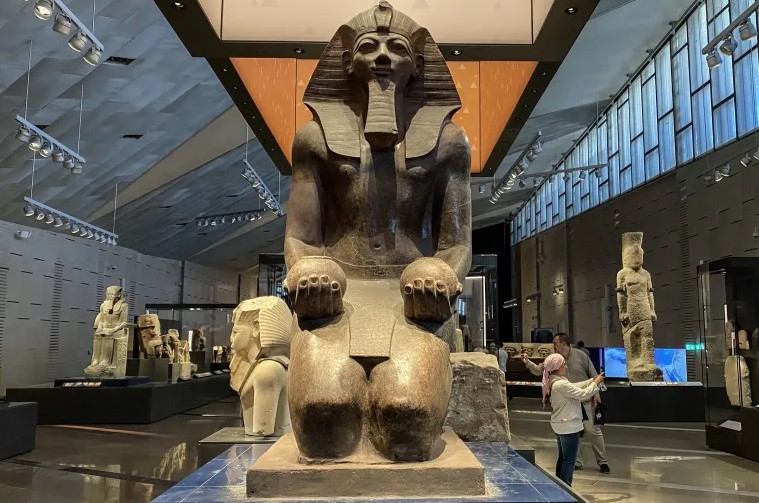
It’s always seemed that Egypt’s story is just too big for any one building. Somehow, though, the Grand Egyptian Museum manages to come close. It’s not just a museum; it’s an architectural marvel that houses the stories of one of the world’s oldest, and most extraordinary, civilizations it was built to honor.
Started in 2003, the museum took more than two decades to complete, which only adds to its sense of anticipation and significance.
The idea was to build something that would match the scale of Egypt’s legacy – not only in size but in ambition. After years of planning, delays, and quiet anticipation, the museum opened in 2025, and the impact has been immediate.
It’s been called the largest museum in the world dedicated to a single civilization, and that distinction feels earned.
The building itself was designed by Heneghan Peng Architects, an Irish firm whose work blends sleek contemporary lines with a deep sense of place. The result is a structure that looks both futuristic and ancient at the same time. The angles and textures echo the pyramids right across the way, so you never forget where you are, and where this story began.
And the scale is astonishing. The Grand Egyptian Museum covers roughly 5.4 million square feet, making it one of the largest museum complexes in the world which seems entirely appropriate.
Egypt’s story is so vast, so layered, and so influential that it deserves a home of extraordinary ambition.
It houses more than 100,000 artifacts, stretching across roughly 7,000 years of Egyptian history.
Think about that for a moment: from the earliest beginnings of Egyptian life through to the Greco‑Roman era, all gathered under one roof.
One of the greatest treasures of the museum is the complete Tutankhamun collection. For the first time, the full contents of the boy king’s tomb can be seen together, offering a more complete and moving picture of one of Egypt’s most famous rulers. This is not simply a display of gold and glamour, though there is certainly plenty of that. It is a chance to see ancient Egypt as a living civilization, full of ritual, power, artistry, and human mystery.
The museum also includes the monumental Khufu solar boat, an extraordinary artifact that speaks to the engineering skill and spiritual beliefs of the ancient Egyptians. Pieces like this remind us that Egypt was never just a land of monuments. It was a society of thinkers, builders, priests, rulers, and craftsmen whose work still astonishes the modern world.
What makes the Grand Egyptian Museum especially compelling is that it is not merely a repository for the past. It is a bold reintroduction of Egypt to itself and to the world. The building, the collection, and the location all work together to create something rare: a museum that feels historic the moment you hear about it.
For me, the Grand Egyptian Museum feels like a gift. It’s Egypt deciding to tell its own story, on its own terms, with confidence and pride. It’s not just about honoring the past; it’s about inviting the world to walk through it, think about it, and feel its presence in a very real way.
In every sense, the Grand Egyptian Museum is a masterpiece in the making – a place where ancient memory meets modern vision,


Leave a Reply