
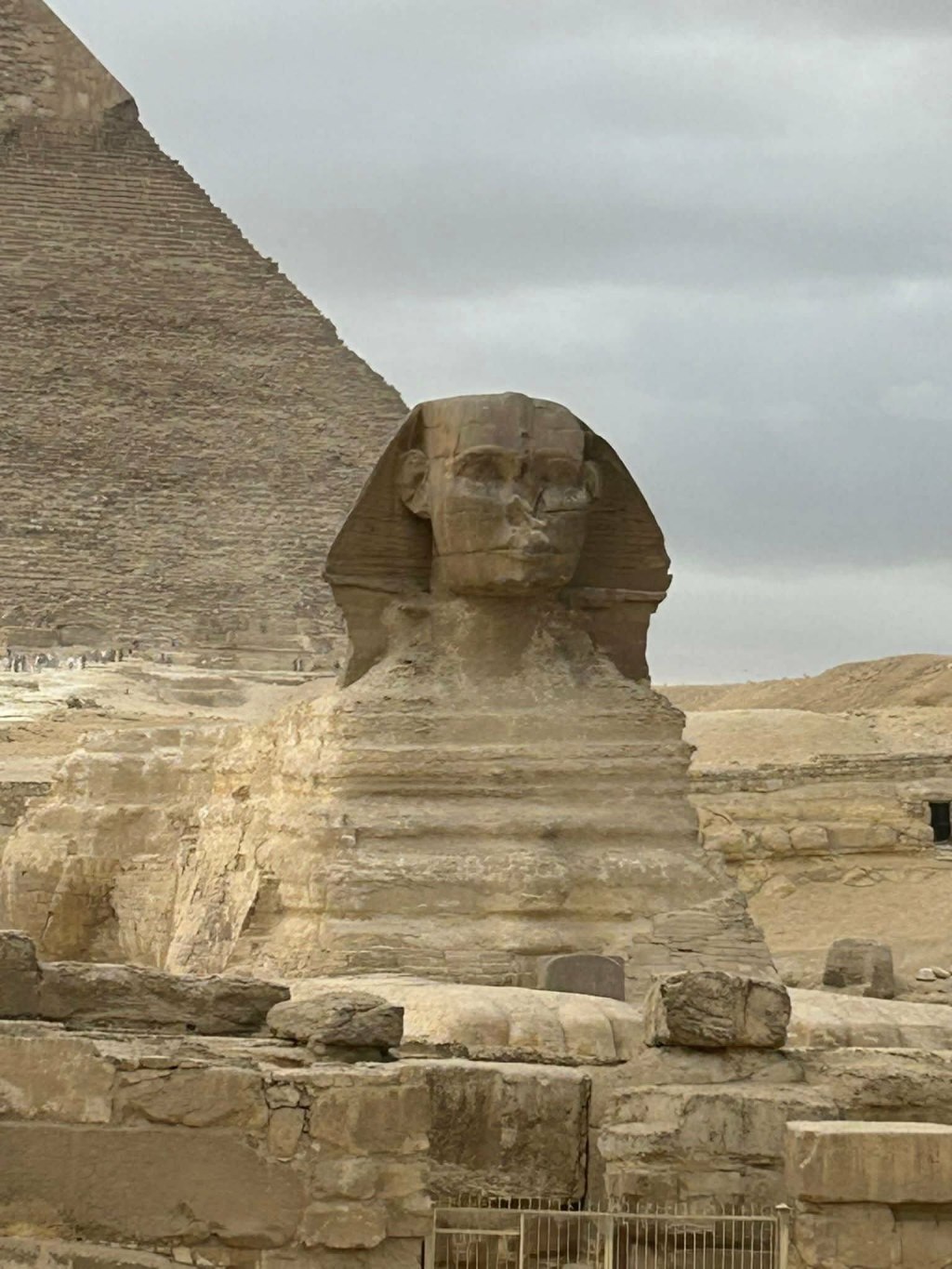
The Great Sphinx of Giza
is one of the most iconic monuments in the world, and one of the most debated. Standing on the Giza Plateau beside the pyramids, this massive limestone figure has watched over Egypt for thousands of years, or so the conventional story goes. To many visitors, it is simply a giant guardian statue with a lion’s body and a human head. But to historians, archaeologists, and alternative researchers, the Sphinx is much more than that. It is a monument filled with unanswered questions about who built it, when it was built, why it was carved, and whether it may be far older than the mainstream timeline suggests.
The Great Sphinx is a monumental limestone statue carved directly from the bedrock of the Giza Plateau. It measures about 240 feet long and about 66 feet high, making it one of the largest single-stone sculptures ever created. It has the body of a lion and the head of a human, traditionally interpreted as a royal portrait, most commonly associated with Pharaoh Khafre of Egypt’s Fourth Dynasty. The statue faces east, toward the rising sun, which has led many scholars to connect it with solar symbolism, kingship, and divine protection.
The Sphinx has long been a symbol of mystery. Even in antiquity, people seem to have regarded it as ancient and powerful. Over time, sand buried much of the statue, leaving only the head visible for long periods of history. Its rediscovery and excavation in the modern era renewed global fascination and opened the door to more questions than answers.
The Standard History
In the mainstream scholarly view, the Great Sphinx was built during the Old Kingdom, likely around 2500 BCE, during the reign of Pharaoh Khafre. This theory is based on the Sphinx’s proximity to Khafre’s pyramid complex, stylistic comparisons, and the architectural relationship between the statue and nearby structures. Many Egyptologists believe the monument was carved by teams of laborers who removed the limestone around a natural outcrop, shaping the remaining bedrock into the body of the Sphinx.
This explanation fits with what is known about Old Kingdom engineering. Ancient Egyptians were highly skilled builders who created pyramids, temples, tombs, and enormous statues using copper tools, stone hammers, wooden sledges, and enormous labor forces. The Sphinx was likely part of a larger sacred landscape intended to reinforce the pharaoh’s power and link him to the sun god Ra.
Still, even within the mainstream view, there are uncertainties. There is no surviving inscription that says clearly, “Khafre built the Sphinx.” Scholars rely on circumstantial evidence, which is strong but not absolute. That ambiguity is one reason alternative theories continue to attract attention.
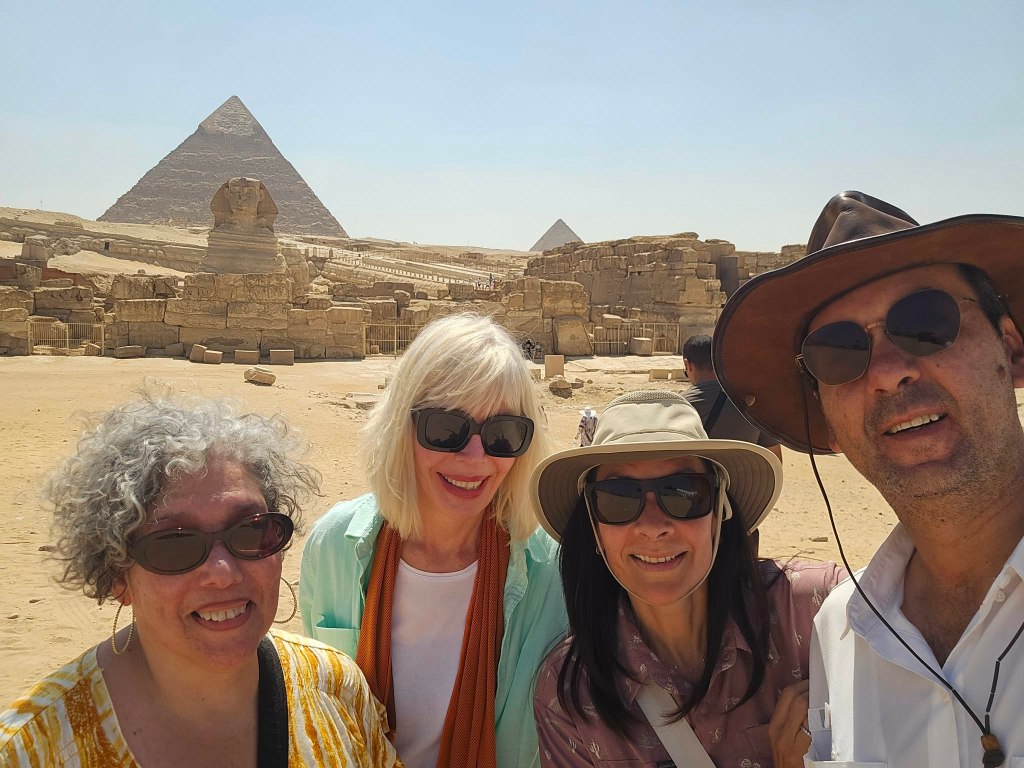
The author, Egyptologist Fouad Berto, and guests at the Sphinx during a recent small group tour to Egypt.
Erosion and the Age Debate
One of the most controversial arguments about the Sphinx concerns erosion. Some researchers have suggested that the weathering on the Sphinx’s enclosure walls looks more like damage caused by heavy rainfall than by wind and sand alone. If that is true, it could imply that the monument is much older than the accepted Old Kingdom date, possibly predating the drier climate that dominated Egypt around 2500 BCE.
This theory is most often associated with the idea that the Sphinx was built in a far wetter era, perhaps thousands of years earlier than mainstream archaeology allows. Supporters point to vertical erosion channels on the enclosure walls and say they resemble water runoff patterns. Critics respond that other factors, including salt crystallization, groundwater, restoration work, and long-term exposure, can also produce unusual erosion. They argue that the evidence does not require a prehistoric date.
Even so, the erosion debate remains one of the most discussed aspects of the Sphinx mystery. It is not just a matter of rock damage; it is a question of climate history, geology, and the possibility that conventional chronology may be incomplete. For many people, this is where the Sphinx becomes more than an Egyptian monument. It becomes a challenge to the standard timeline of civilization.
Was the Head Changed?
Another controversial theory is that the Sphinx may not always have had the same head it has today. Because the head is much smaller proportionally than the body, some researchers have argued that it may have been recarved from an earlier statue. In this view, the original form could have been a lion’s head, a jackal’s head, or another animal head, later reshaped into a human face by a pharaoh who reused an older monument.
This theory is appealing because the head appears unusually small compared to the body, and the facial features seem more stylized than the massive body itself. If the statue was originally a lion, that would fit the overall lion form of the body and strengthen symbolic connections to the constellation Leo. Some alternative historians suggest that if the Sphinx originally represented Leo, then its date could correspond to a time when the constellation occupied a specific astronomical position, potentially aligning with a much earlier epoch.
Mainstream Egyptology generally rejects this idea. The common explanation is that the head is small because the limestone layer from which it was carved was less durable than the body, forcing the sculptors to leave it proportionally smaller to avoid collapse. In other words, the head may look odd not because it was recarved, but because geology imposed limits on the design. Still, the possibility of reworking has not disappeared from popular discussion.
The Leo Connection
The idea that the Sphinx may be linked to the constellation Leo is one of the most famous esoteric theories surrounding the monument. According to this view, the lion body of the Sphinx is not accidental. It may reflect a deliberate astronomical design, representing the sign or constellation of Leo at a specific moment in prehistory. Some researchers have argued that the Sphinx’s eastward orientation, along with celestial alignments on the Giza Plateau, could indicate that the monument was created to mark an age when the sun rose in Leo during the spring equinox.
This theory gained wide public attention because it suggests a far older civilization than the one usually credited with building the Sphinx. In that scenario, the monument would not be a Fourth Dynasty creation at all, but a surviving relic of a lost earlier culture that possessed advanced astronomical knowledge.
The problem is that this idea is highly speculative. It depends on assumptions about ancient sky watching, symbolic intent, and chronology that are difficult to prove. Still, its appeal is strong because the Sphinx’s lion body makes the Leo connection feel almost too perfect to ignore. That combination of symbolism, astronomy, and mystery is part of what keeps the theory alive.
Hidden Chambers and Tunnels
Few subjects around the Sphinx generate more fascination than what might lie beneath it. Over the years, there have been claims of tunnels, shafts, passageways, and hidden chambers in or near the monument. Some are real and documented, while others belong to the realm of rumor and speculation. Archaeologists have confirmed that there are cavities and man-made features in the area, but there is no verified evidence of a secret underground library or a vast buried chamber system beneath the paws.
The idea of hidden spaces has been fueled by reports of exploratory drilling, seismic studies, and limited investigations around the Sphinx enclosure. Because the monument sits in a complex archaeological zone, it is possible that undiscovered features remain nearby. But the leap from “there may be voids or cavities” to “there is a grand hidden chamber under the Sphinx” is a very large one.
Still, the mystery persists. The paws, the enclosure floor, and the bedrock beneath the monument have all inspired theories about sealed entrances, forgotten technology, and ancient records. These ideas are not supported by consensus evidence, but they remain part of the Sphinx’s cultural afterlife.
The Sphinx’ Paws
Edgar Cayce, the 20th-century American clairvoyant often dubbed the “Sleeping Prophet” described a hidden chamber near the Sphinx – often said to be near its right paw – containing records from Atlantis and early Egypt, but it is considered a fringe / esoteric idea, not a confirmed archaeological discovery and no conclusive physical evidence has been found.
The idea remains popular because it blends mystery, spirituality, and lost-history speculation. Supporters claim geophysical surveys and anomalies beneath the Giza Plateau suggest something may be there, but mainstream archaeologists have not verified a sealed Hall of Records under the Sphinx.
In short, the Cayce theory is best understood as a modern legend attached to the Sphinx: intriguing, influential, and widely discussed, but still unproven.
Why the Mysteries Endure
The Great Sphinx continues to inspire fascination because it sits at the intersection of history and legend. On one hand, it is an extraordinary example of ancient Egyptian craftsmanship, religious symbolism, and royal power. On the other hand, it is surrounded by real gaps in knowledge. There is no final inscription explaining everything about it, no universally accepted answer about its origin, and no complete certainty about its deeper meaning.
That is why the Sphinx attracts both scholars and dreamers. For some, it is a masterpiece of Old Kingdom engineering. For others, it is evidence of a lost chapter of human history. The truth may be less dramatic than the myths, or it may be more surprising than we expect. In either case, the Sphinx refuses to become ordinary.
What Does All This Mean?
The Great Sphinx of Egypt remains one of the world’s most powerful symbols of ancient civilization. The mainstream view places it in the Old Kingdom, likely under Khafre, carved from the limestone bedrock of Giza as part of a royal and solar sacred landscape. But controversial theories continue to challenge that picture, raising questions about erosion, age, hidden chambers, and even whether the monument once had a different head aligned with the constellation of Leo.
Whether you see it as a royal guardian, a prehistoric enigma, or a monument that preserves clues to a forgotten past, the Sphinx continues to command attention. Its silence is part of its power. The more people study it, the more it seems to ask the same question again and again: how much of human history have we really understood?


Leave a Reply