
There are places in Egypt where history is clearly written in hieroglyphs,
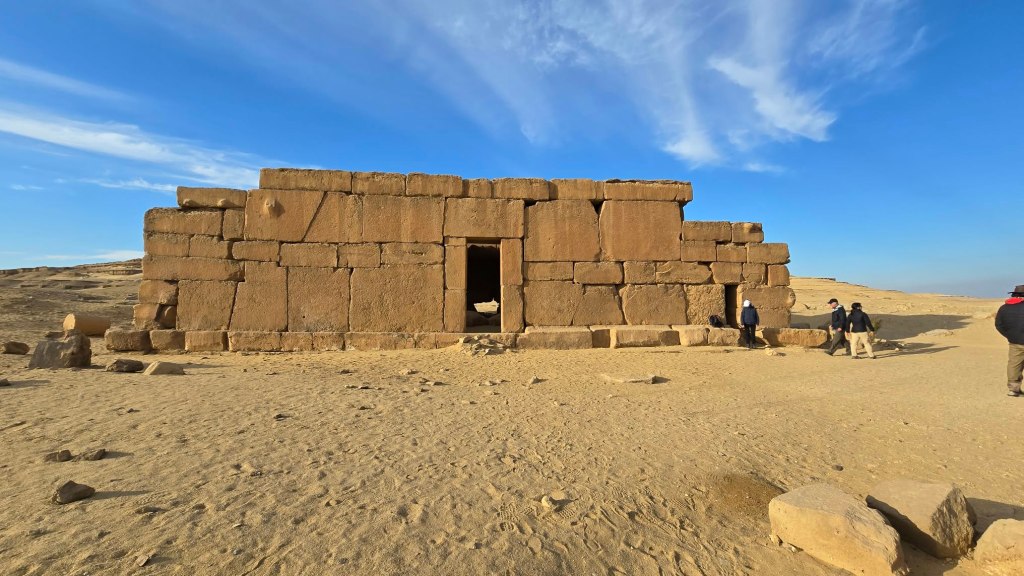
carved into monumental gateways, and explained by generations of archaeologists. Then there is Qasr El-Sagha – a sandstone structure rising from the Western desert north of Lake Qarun, where the silence is almost as compelling as the ruins themselves.
Often called the “Golden Fortress” or “Palace of the Goldsmith,” Qasr El-Sagha is one of Fayoum’s most intriguing archaeological sites. Its unfinished walls, unusual design, and complete lack of inscriptions have left visitors and scholars wondering about its original purpose. Was it a temple? A ceremonial building? A waystation overlooking the ancient lake? Or was it part of a much older landscape whose secrets have not yet been fully understood?
The unfinished appearance of the monument is especially striking. Portions of the building were never decorated, and certain details seem incomplete. There are no dramatic wall scenes showing offerings to the gods, no royal victory inscriptions, and no clear explanation of why the structure was built.
To appreciate the mystery of Qasr El-Sagha, it helps to first understand a little of Fayoum itself.
Fayoum: Egypt’s Oasis of Contrasts
Located southwest of Cairo, about a 2-hour drive from the city itself, Fayoum is one of Egypt’s most distinctive regions. Unlike the narrow agricultural corridor along the Nile, Fayoum spreads into a broad depression surrounded by desert. Within this basin are fertile fields, palm groves, fishing villages, ancient ruins, wildlife, and shimmering lakes.
The region’s modern landscape is closely connected to the ancient Lake Moeris, a much larger body of water associated with the Fayoum Depression. Over thousands of years, water levels changed, canals were developed, and sections of the lake were reclaimed for agriculture. Today, Lake Qarun occupies part of this ancient watery landscape.
The result is a destination of remarkable contrasts. In a single car trip, travelers can move from green farmland to golden desert, from lakeside villages to fossil-filled valleys, and from Greco-Roman ruins to monuments dating back more than 4,000 years.
Fayoum is also a region where nature and history exist side by side. Wadi El-Hitan, or the Valley of the Whales, lies within the wider Wadi El-Rayan Protected Area. This UNESCO World Heritage Site contains exceptionally preserved fossils of ancient whales, documenting the evolutionary transition from land-dwelling mammals to ocean-going animals. UNESCO describes it as one of the world’s most important sites for understanding the evolution of whales.
Yet even among Fayoum’s celebrated attractions, Qasr El-Sagha remains different. It is quieter – it feels independent, in a way – more isolated, and far less immediately understandable.
Approaching the “Golden Fortress”
Qasr El-Sagha stands on the northern side of Lake Qarun, near the escarpment of Gebel Qatrani. In antiquity, the surrounding landscape looked very different. The lake extended farther into the Fayoum Depression, and the temple may have stood closer to the water’s edge than it does today.
From a distance, the structure can appear almost like part of the desert itself. Its local sandstone blocks blend into the surrounding hills, and there are no towering columns or brightly painted reliefs to announce its presence. Instead, Qasr El-Sagha feels discovered rather than displayed.
The monument was documented by the German explorer and botanist Georg Schweinfurth in the nineteenth century. Later archaeological investigations, including work associated with the German Archaeological Institute, examined the temple’s architecture and relationship to nearby settlements and cemeteries.
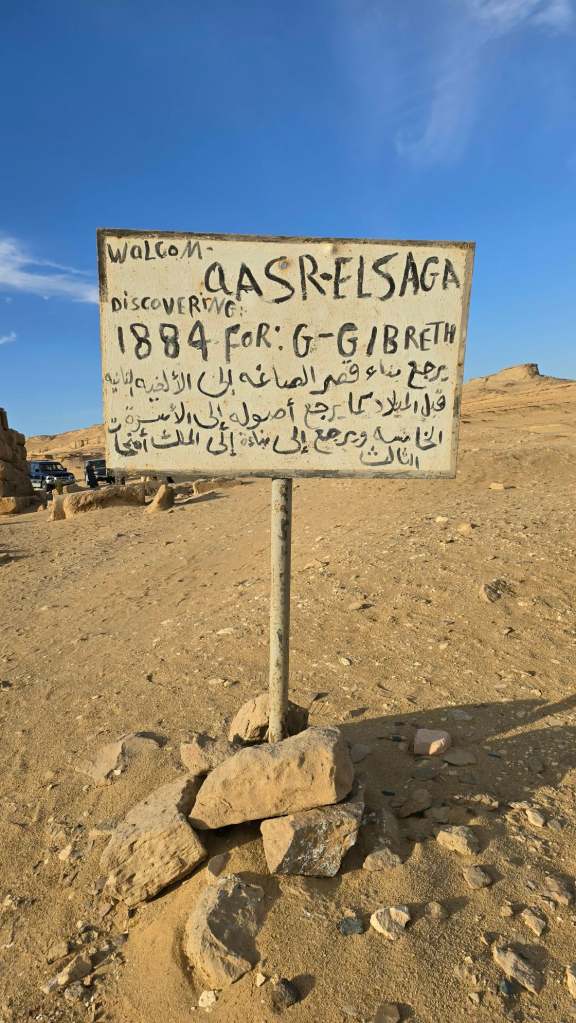
Most scholars place the structure within Egypt’s Middle Kingdom, probably during the Twelfth Dynasty, when Fayoum received considerable royal attention. This was a period of ambitious irrigation projects, agricultural development, royal building programs, and renewed interest in the region. The dating, however, is not as straightforward as it might be for a monument covered in royal names and dedicatory inscriptions.
That uncertainty is central to Qasr El-Sagha’s mystery.
An Unfinished Temple
Qasr El-Sagha was built from large blocks of local sandstone. The masonry is impressive, but the building appears incomplete. Several surfaces are undecorated, and the monument contains no inscriptions identifying a king, deity, architect, or intended function.
The arrangement does not conform neatly to the familiar image of an ancient Egyptian temple with a monumental pylon, processional axis, hypostyle hall, and sanctuary decorated with scenes of worship.
The interior includes a series of chambers, recesses, and unusual spaces. Some rooms appear to have been carefully planned, while others seem never to have been completed.
These unusual aspects have led to plenty of speculation.
One possibility is that Qasr El-Sagha served a religious purpose connected to the ancient lake and the landscape around it. Water, fertility, agriculture, and royal authority were deeply connected in Egyptian thought, and Fayoum was an important agricultural region.
Water was central to life in the area, and a sacred building overlooking Lake Moeris could have played a ceremonial or administrative role.
It is also possible that the site served as a station along an ancient route or had some administrative purpose connected with the surrounding agricultural land. A structure overlooking Lake Moeris may have played a ceremonial or administrative role linked to the lake’s changing waters.
Another interpretation is that it was not a conventional temple at all. Some researchers have considered whether the building could have functioned as a lookout point, a storage or control facility, a quarry-related structure, or a ceremonial station along an ancient route.
Another possibility is that the building was abandoned before construction was finished. Perhaps political priorities changed, funding ran out, or the site lost its importance as the lake and surrounding settlements developed.
The truth may be a combination of these possibilities. Qasr El-Sagha could have been planned as a religious monument but never fully completed or used as intended.
This raises a series of questions:
Why was the building constructed in such an isolated location?
Which deity, if any, was worshipped there?
Was it intended for public ceremonies or restricted rituals?
Did its function change during construction?
Was it ever used in the way its architecture suggests?
Without inscriptions, there is no definitive answer.
The Mystery of Its Age
As mentioned above, Qasr El-Sagha has generally been associated with the Middle Kingdom based on architectural comparisons, nearby archaeological evidence, and the history of Fayoum during the Twelfth Dynasty.
Its design has also encouraged comparisons with earlier Egyptian architecture. The temple’s heavy stonework and austere appearance can seem older than its proposed date, leading to speculation that an earlier structure may have existed on the site or that later builders deliberately used archaic architectural forms.
This is an important distinction. Ancient Egyptian builders sometimes revived older styles to create an impression of tradition and sacred authority. A monument that looks ancient may not necessarily have been built in the earliest period of Egyptian history.
At the same time, Qasr El-Sagha’s lack of inscriptions means that the dating debate cannot be resolved as easily as it might at a monument bearing a clear royal cartouche. The site therefore demonstrates one of archaeology’s most fascinating realities: even when the stones remain, the original story can remain hidden.
A Journey Beyond the Ruins
A visit to Qasr El-Sagha is best understood as part of a larger Fayoum experience rather than as a quick stop at an isolated monument.
Nearby Lake Qarun offers a striking contrast to the dry hills. Depending on the season and light, the lake can appear silver, blue, or bronze beneath the desert sky.
The surrounding landscape is as important as the temple itself. Lake Qarun reflects the changing colors of the sky, while the desert hills provide a dramatic backdrop. Depending on the time of day, the site can feel completely different. Early morning brings soft light and cooler temperatures; late afternoon casts long shadows across the sandstone and makes the ruins appear even more atmospheric, while birds and fishing activity add movement to the otherwise still landscape.
Qasr El-Sagha and its environs invite additional questions rather than providing easy answers. Who planned the building? Why was it placed above the ancient lake? Was it ever completed? What ceremonies may have taken place inside? And why was it eventually left behind?
There may never be a single answer to all of these questions. Yet that is what makes a visit so worthwhile. The unfinished walls allow room for imagination, while the surrounding desert reminds visitors that landscapes change just as civilizations do.
Other Sites in the Area
For travelers interested in archaeology, Fayoum also offers connections to the Greco-Roman period, including the ruins of Karanis and other ancient settlements around the lake. These sites reveal how the region continued to thrive long after the Middle Kingdom, serving as a meeting point for Egyptian, Greek, and Roman cultures.
The wider region also includes Wadi El-Rayan, known for its desert lakes and waterfalls, and Wadi El-Hitan, where fossilized whale skeletons lie exposed in the desert. Because Wadi El-Hitan is a protected World Heritage property, visits are controlled and organized along designated routes to safeguard the fossils and surrounding environment.
It’s all so extraordinary and immense.
The Mystery
Qasr El-Sagha does not offer easy answers – and that is precisely why it remains memorable.
Many of Egypt’s most famous monuments communicate their purpose through scale, decoration, and inscriptions. communicates through absence. Its missing texts, unfinished chambers, and isolated setting invite travelers to look more carefully and imagine the people who planned, built, abandoned, or perhaps briefly used it.
Standing among the sandstone blocks, it is possible to picture a very different Fayoum: a wider lake, busy waterways, royal estates, fertile fields, and desert routes leading toward distant settlements. The temple may once have been part of that living landscape. Today, it stands as a fragment of it.
For those willing to travel beyond Egypt’s most familiar monuments,
Fayoum offers something rare: an encounter with a landscape where natural history, ancient engineering, royal ambition, and archaeological mystery overlap.
And at the heart of that landscape, Qasr El-Sagha continues to stand, and wait, patiently, quietly, and without revealing all its secrets.


Leave a Reply